We managed to get Sue and Dave up and away quite early, and we set off down to Fishbourne, near the Hampshire coast. We had only been driving about 10 minutes when a cop stopped Dave for driving too fast. Dave pissed him off by shouting, ”What’s up now?” at him, so he got a 40 quid ticket for his trouble. We arrived at Fishbourne at 10.30, and paid to go into the complex, where, in 1960, the remains of a huge Roman palace were discovered.
The huge palace, over 100 metres down each side, was begun in around 43 AD as granaries to support Roman conquests. It evolved with the construction of comfortable timber-frame residential buildings, which were later replaced by a stone-walled villa or proto-palace around 65 AD, featuring luxurious amenities like a courtyard garden and bath suite, decorated with fine art and materials. This proto-palace was part of a trend among local aristocrats employing foreign craftsmen for elaborate constructions.
By 75-80 AD, a full-sized palace was developed, incorporating the proto-palace and featuring extensive gardens, under-floor heating, an integral bathhouse, and sophisticated mosaics. The palace was a centre of luxury, with elaborate decorations and functional amenities, reflecting high craftsmanship and foreign influences.
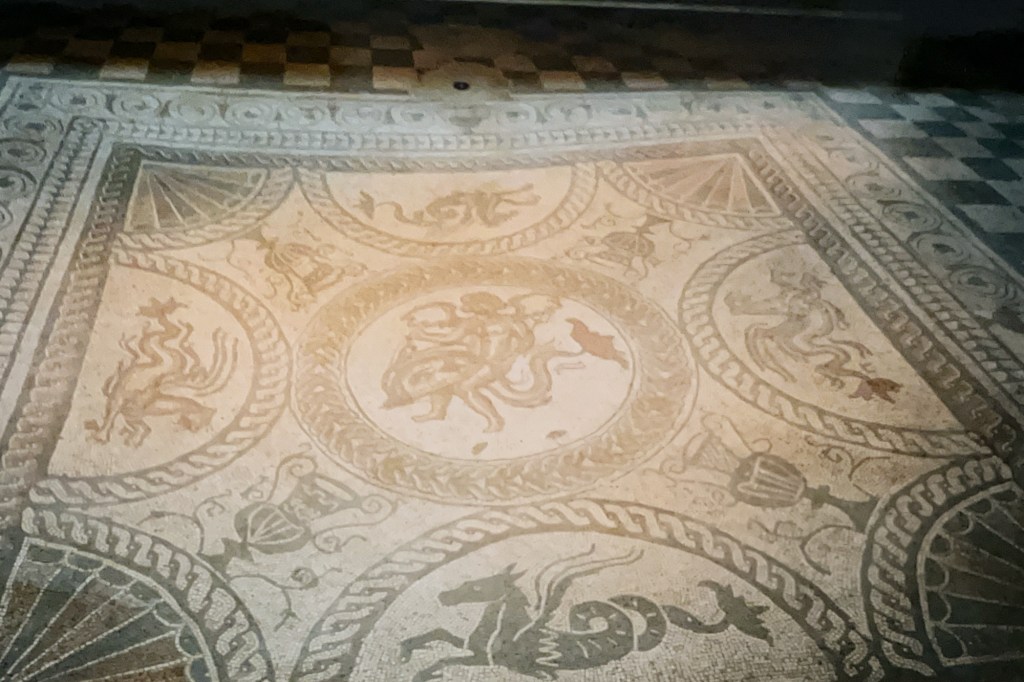
It underwent several phases of expansion and remodelling, including new baths and mosaics, until significant parts were destroyed by a fire around 270 AD, leading to its eventual abandonment and dismantling. The site later served as a burial ground in the early Saxon period and was rediscovered in the 19th century.
Ownership theories include Tiberius Claudius Cogidubnus, a pro-Roman local king, Sallustius Lucullus, a Roman governor, and other notable figures, indicating the palace’s significance in Roman Britain. The final destruction of the palace is attributed to a fire, possibly linked to political instability, and the site’s later desolation was exacerbated by environmental factors and looting for building materials.

From Fishbourne we drove down to Bognor Regis, where a moody sky shed light down onto the stone beach washed by a grubby sea and fat, horrible people ate cockles and rock as they strolled along the garish promenade. On the way back to Farnham we stopped for a picnic in the huge grounds of Petworth Estate.


 CurseOfTheTraveller