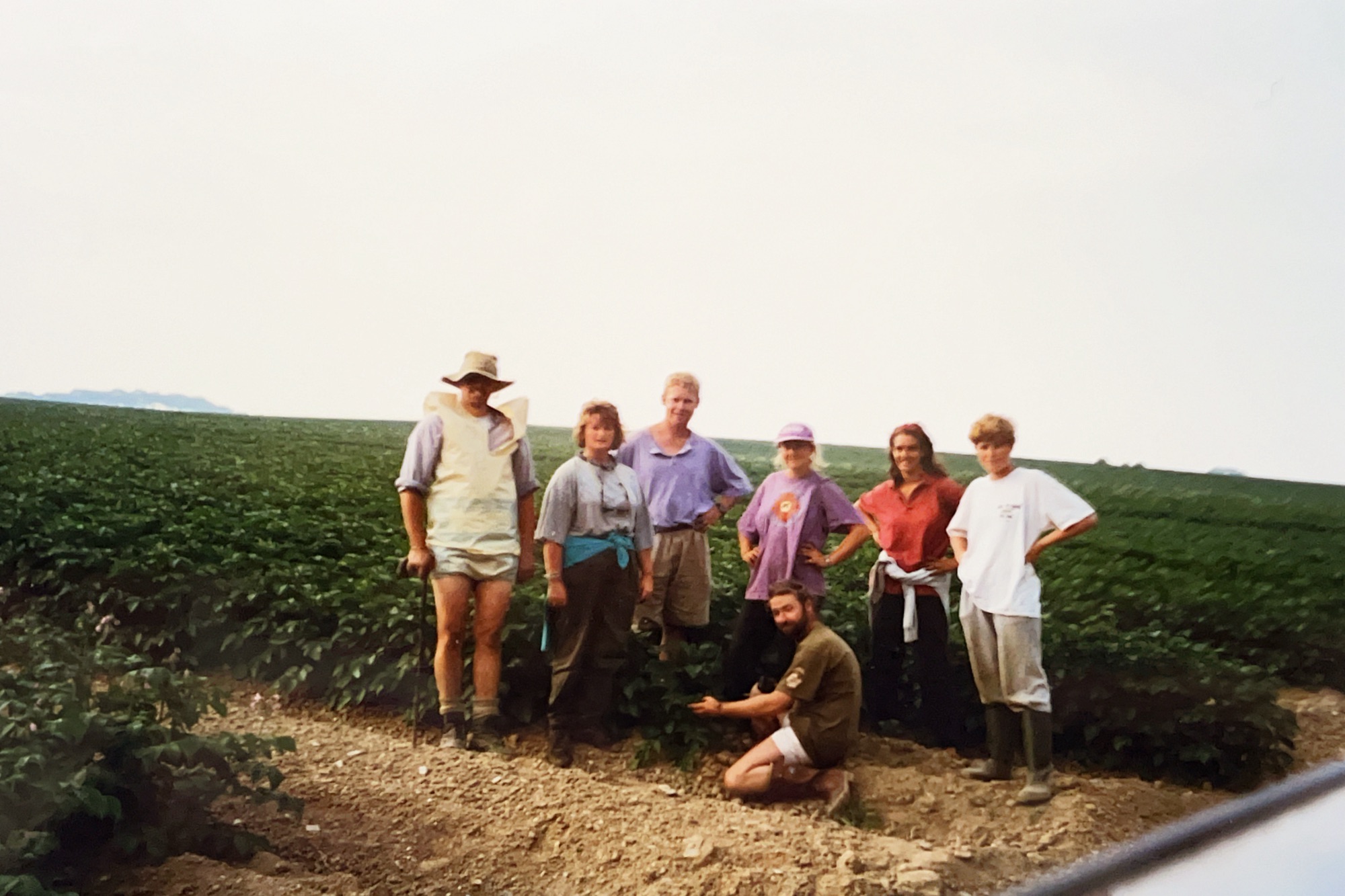
Magnus and Jen had arranged for all of us to help them “rogue” a field of tatties. We started at 9am, walking in a line up the bushy rows of plants, searching out plants showing sign of the disease blackleg, which causes the leaves to wilt and curl.
Although the job was less than enthralling, there were seven of us doing it — Ferg, Linda, Blue, Kerry, Magnus, Jen, and Lucy — so we were able to chat and this helped to pass the time. We went into the nearby village of Turriff for a bar lunch, then returned to the tattie field, where we worked until 6pm. A grey haze had crept in during the afternoon, but it was hot and humid, and not unpleasant.
After work, we all went for a pint at the Drum Inn near Old Meldrum and we stayed there until around 9.30, then drove over to Magnus’s flat in the servants’ quarters of an old house. It was a strange and beautiful evening, warm and still, with a thick, glowing mist sheathing the air. We walked through a short strip of darkened pine trees and emerged at the edge of a cornfield surrounded by trees. The crop was a beautiful pale yellow tinged with green, and the air was tinted violet in the glowing half-light.
At the edge of the field, nestled against the pine, stood a weatherboard building which Magnus’s brother, Mark, uses as a studio. One wall was almost entirely covered by bay windows, which let lots of natural light into the building, which was crammed with artist’s paraphernalia, half-finished etchings, and piles of photographs. Magnus explained that the original owner of the estate had built the studio to entice a wayward artistic son home from France.
On the opposite side of the big house, we entered the gardens by way of a narrow, dark passage through dense foliage. The gardens were massive and fragrant with a wonderfully unkempt feeling. We wandered along grassy pathways through the sprawling garden with the dark shapes of surrounding conifers framed by the glowing sky, surrounded by jumbles of wild and ornamental flowers.
In a circular clearing stood a small fountain, which Magnus turned on. The gentle patter of falling water was the only sound to be heard, and I thought how Middle Eastern fountains are the product of dry countries. In another quiet corner, surrounded by holly, stood a serene statue of St Francis of Assisi, wearing a crown of moss and holding out his hand to a small bird. It was a perfect setting for a statue of the man who proposed that nature is God rather than the other way around.
We wandered down a long grove of conifers to a small lake in a field, and sat quietly in the stillness on the reed-fringe shore. It seemed to me to be the epitome of British scenes: the exact image. The mist-filled air seemed to still glow with the unseen light of the sun, now completely gone from the day, and bats flitted about: ethereal shapes darting across the periphery of our vision. The glassy surface of the lake was occasionally broken by a splash of a jumping fish, and, off in the distance, ducks squabbled and flapped. Walking back to the house through another grove of darkened trees, every one of us walked alone, reflecting on the beauty and tranquillity of the place.

 CurseOfTheTraveller