I was up at 5.30am and carrying my bag full of camera gear, set off into the cold, dewy morning to explore the hillforts over at Westminster. I followed the path down through the fields below the village, crossed the silent railway lines, then carried on across the meadows towards Haytesbury. The air was damp and cold, and a thin mist hugged the ground alongside the Wylye River with clammy arms. I stopped and watched a herd of dairy cows — big, mellow Friesians — waking up and stretching, their breath enveloping them with steam at each exhalation.
Crossing a cornfield, the sun appeared, fat and red from behind the ranges, and a warm glow radiated down from the sky. Haytesbury was sound asleep as I walked up past the church, with its silent scattering of headstones, and crossed the main road to the foot of the ranges. A cold wind was blowing out of the east as I topped the first hill, with its tumulti and earthworks, and a grey haze of fog was beginning to fill the sky, as if a change in the weather was coming.
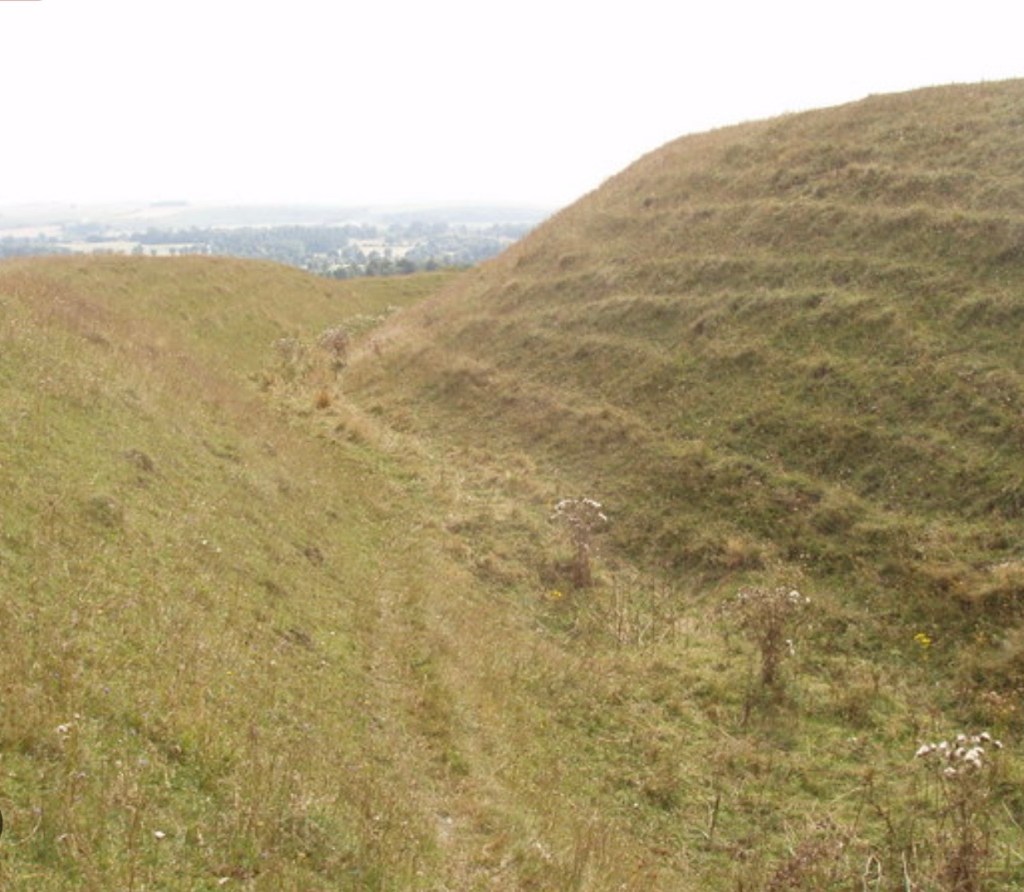
I walked along the hilltop and crossed a field of wheat to the foot of the enormous earthworks of Battlebury Hill. The outer perimeter was huge, fully 10 metres high, with a ditch facing out from the foot of the battlements. I climbed to the top and began walking right, anticlockwise, along the summit of the mound.
TRANSCRIPT FROM MY DICTAPHONE
Here on the top of the hill near Westminster, known as Battlebury Hill, it’s quite amazing. A huge ring of battlements running right around the top of the hill, gouged out for who knows what and how long ago. I am sitting on the eastern side of the hill. There’s a cold wind blowing from the north, and I’m sitting behind a bush, sheltering while I change the film and the camera. Across the other side of the valley from here, the farmland seems to finish, turns into the rolling Salisbury Plain. Grassland dotted with trees and bushes. Most of it, I guess, is army rangeland. It is cold this morning, and hazy with a sort of fog in the sky, as if there is rain coming somewhere. There are tumulti everywhere up here, each one no doubt containing the remains of some important person who lived up here hundreds, thousands of years ago, quite ghostly some of them.
TRANSCRIPT ENDS
In fact, the hilltop forts that dot the English landscape, especially in southern England, were built by men of the Neolithic age, pre-1000 BC, and the Iron Age, 400 BC to 50 AD. They were built on hilltops above the vast tracts of forest and swamp which once covered most of southern England.
Life in those primeval days must have been terrifying for the few humans that peopled the forests of the island. Not for them any of today’s cocky understanding of the natural world. For them, the world was an almost total enigma, full of spirits and danger, and of things beyond their comprehension. Thus, they nervously eked out their existence.
TRANSCRIPT
I’ve just moved away from the shelter of the bush, out into the wind, walking out across the middle of the area behind the battlements, which I guess would have held some sort of village. There are cows grazing here now, and ragwort growing, yellow flowers amongst the grass. All around, lower down, there’s fog in the sky, right round. Apart from the earthworks up on the hill, there is nothing to give any clue about who lived here, or why
There looks to have been some three kinds of defence. The large outer perimeter ditch, fully 6 to 8 metres high. 50 metres back from that there is a smaller ditch, which probably held sharp sticks along the top. Then a further 50 metres back, the remnants of another ditch that has almost rejoined the slope of the hill, probably another picket line.
I’ve just stopped on top of a tumultus, looking over BishopStrow. Just now, I’m walking around the lowermost ditch. Must have been very hard digging here in the chalk soil and flint. But the fortifications would have proved a formidable obstacle for anyone trying to attack it.
TRANSCRIPT ENDS
Walking down off the hill, I followed a byway down onto the floor of the valley, past a row of lynchets [ancient terraces] on the hillside of Middle Hill, to the edge of the Salisbury Plain itself. Several signs gave dire warnings of the dangers of proceeding any further onto Defence Department land. It would be nice, I thought, to just keep walking out across this beautiful stretch of ranges, and not stop until I reached Marlborough on the far side.
TRANSCRIPT
The sign contained the Statutory Instruments No. 123 of the Army Ranges. There is a list of things that you can do, and mainly what you can’t do. Tells you who’s allowed to arrest you if you’re caught out there, and at the very bottom of it says, “by Section 17 of the Military Lands Act 1892, it is provided that any person commits an offence against any bylaw under this Act, he shall be liable to a conviction before a court of summary jurisdiction to a fine not exceeding five pounds.”
TRANSCRIPT ENDS
I figured that I could afford five pounds should I get caught, so walked along the edge of the rifle range, until I came to the next bridle path, which led up onto Scratchbury Hill. From the hill, there was a wonderful view out across the plains, and closer in, a firing range, where derelict tanks were dotted about in a narrow, blind valley.
To the left, there was a grandstand and some bunkers where people obviously sit and watch. Looking east, there was a cluster of old thanks and armoured vehicles painted blue, yellow, and red. Each group had a number or letter beside it. It was obvious that aircraft would fly in and attack them, and tanks woud fire at them. There were a few fresh bomb craters in the ground below, and the area was crisscrossed with tracks made by tanks.
I walked clockwise around Scratchbury Hill, and like the other fort at Battlebury, there were three main defences. The outside rampart was quite thickly forested. I saw a fox dart out of the trees on this middle embankment, a beautiful, rich red colour… renarde: the fox.
It took quite a long time to find my way back into Warminster after descending the steep slope of Battlesbury Hill. On the way down, I passed the School of Infantry beagles out with their keeper for a morning walk. Crossing a cornfield via a path, I entered a maze of horrid houses that make up the School of Infantry ghetto. I stopped at the Quartermaster’s store — the NAAFI (Naval, Army and Air Force Institutes) — for a Coke and a Snickers, then carried on down to the Boreham Road and walked out to Sutton Veny. From there, I rang Linda and she and Anne came down to get me. The afternoon, we caught the bus down to Wilton and stayed the night with Martin and Vicky.

 CurseOfTheTraveller