Up early yet again, I walked around to Sundial Farm to see Richard and Robin Witt. The sky was alight with red, signifying a change in weather, and I paused briefly in the Corton Cemetery: cold, damp, and silent, its headstones slowly tilting and subsiding as the earth in which they are planted moves downhill. The Witt boys were busy in the cow shed, milking their last remaining wet cows, the rest being out for calving. I spent a short while there before walking back round to the cottage, where we finished packing and prepared to leave.
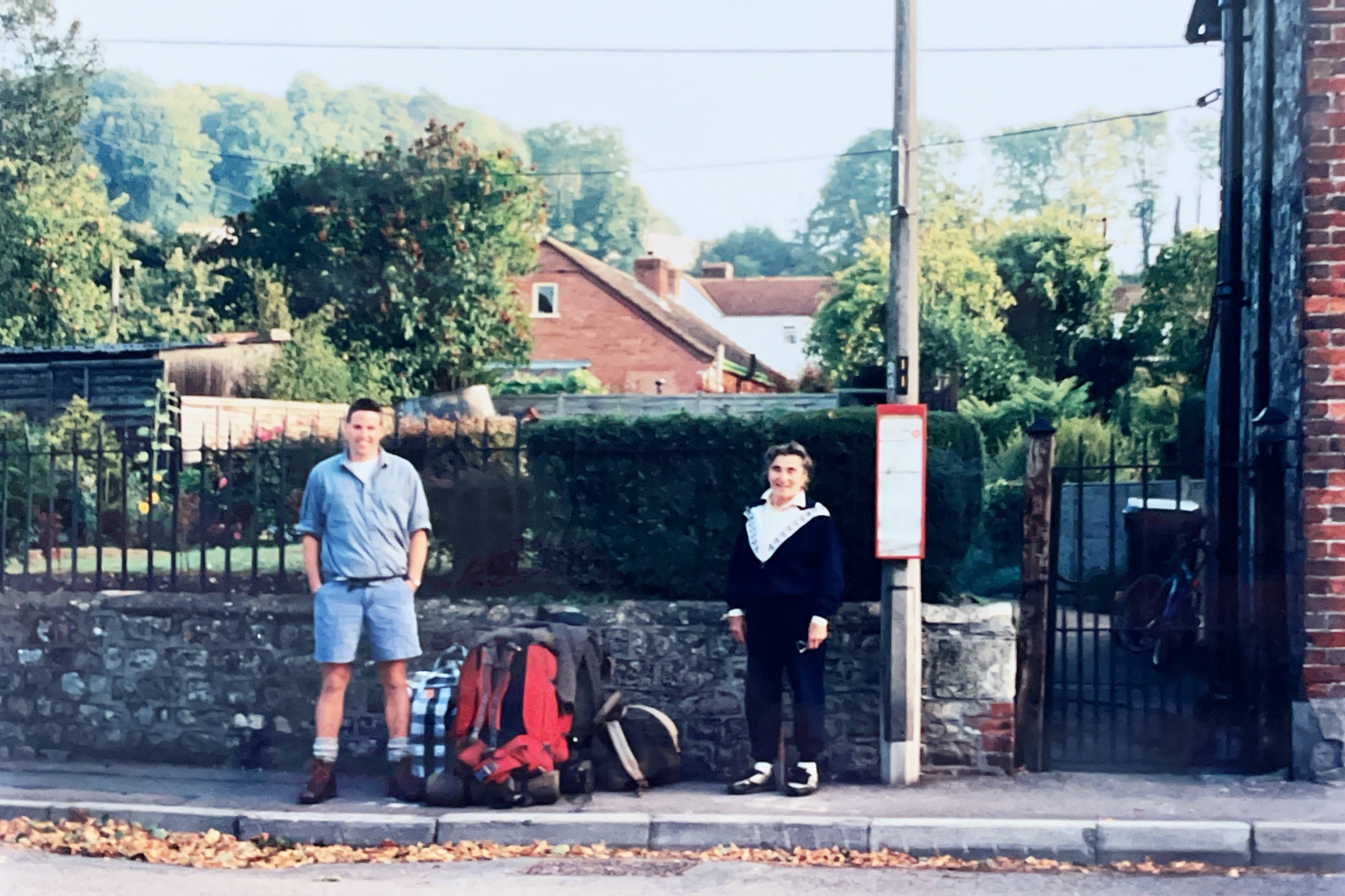
Waiting for Anne, we took a cup of tea each up into the garden and admired its splendour, all dewy and colourful. Anne took us over to Haytesbury, where we caught the bus to Salisbury. She was in fine heart, not a bit sad to see us go, as she said that she was certain we would be back soon. She even offered to send us the airfare!
At Salisbury, we sat in the dingy bus station cafeteria until the bus to Avebury arrived.
NOTE
Self-service Cafeteria and Takeaway, Salisbury Bus Station, 18 August 1994. Smelly. The smell of grease and cigarette smoke. Lime-green decor, vinyl seats green. A fat cow behind the counter in a red smock, tending to the fryers behind the cabinets of seedy cakes. On the wall, the only concession to a tent, a tasteful decoration, three-framed prints of old-time posters advertising Palmer’s Tyres for bicycles and cars, Boverell, a lady golfer, for health, strength, and beauty, and Pete Freen and Co.’s biscuits, two children dressed in smocks, sit looking at a Punch and Judy show. We sat and munched our bacon booties, which were in fact surprisingly nice given the surroundings.
The bus whisked us away out of Salisbury, past Old Sarum, and out around the eastern edge of the Salisbury Plain. En route to Avebury, we stopped at several pretty little market towns — Amesbury, Marlborough — and passed through a beautiful landscape of rolling hills and wooded valleys, dotted with small villages whose church spires always seem to be the dominant feature.
After Marlborough, the landscape began to flatten out and there was an almost palpable feeling of moving into an area of strangeness. Rows of burial mounds began to appear, and several small stone circles. The sky shimmered, a bright white haze covering over the blue, the fields stark and bare. In a green meadow, a long avenue of stones ran up to the crest of a hill, and we were there, in the great circle of Avebury.
For four and a half millennia, this stone circle has stood there on the edge of the windy plain, gradually weathering and shifting to return eventually to flatness again. The sky had filled and was black and ominous as we explored the stones and the deep trenches and mounds that encircled them. Part of the village of Avebury is built within the circle, but significantly the church is outside. No doubt the founders of the church thought that the ring was a pagan place and no spot for a house of god.
Apart from some sheep grazing contentedly amongst one section of the stones and a horde of tourists wandering like druids around the area, the only other visitor to the circle was a mad cat playing about in the stones at the very centre of the complex like some sort of familiar left to watch over the ancient most holy place.
Back at the bus stop outside the Red Lion pub, the only British pub inside a stone circle, we caught the little red bus down to Swindon about half an hour away. Descending from the Marlborough Downs, Swindon looked quite pretty, ranging about over several low hills, crouching in the haze beneath a shimmering sky.
NOTES FROM SWINDON BUS STATION 18/8/94, 14:35 HRS. Busy. Usually, when we get here, rush hour has passed, and the only people waiting around are nutters and drunks, hanging around outside the toilets, red-faced and dirty, abusing each other and anyone passing by.
Today, however, lots of people of all sorts, most of them shabbily dressed and vaguely complaining. Bad-taste clothes seem to be de rigueur here in Swindon Town, home of “Swindon Town FC, a premier team for a premier town.” The car park next to the bus station is a travesty of modern architecture: criss-crossed bars enclosing grey mesh.
In the taxi rank, pot-bellied drivers jostle with each other and constantly toot their horns. There doesn’t seem to be anything to recommend this place. We wait for our bus, the National Express 403 service for London. Behind us (we are first in line) the queue slowly jostles us forward. Word has gone out that the bus is full, and hopeful holders of provisional tickets are eager to be first on. We relax, smug in the knowledge that our tickets were booked a week ago. Overhead, another C41 transport descends into Lineham airbase. Taxis blare their horns. A compressor drill rattles.
NOTES FROM THE M4 MOTORWAY, 16:30 HRS. These roads are too small. The lanes of traffic perform a deadly dance as each vehicle jostles for position. Three lanes opposite are the same. Travelling by bus gives me the opportunity to have a sneaky look into other people’s lives, albeit a fleeting one. From high on the bus, you look down into passing cars, into the private world there. Bored families; businessmen and women, mostly one to a car and talking on cellular phones. Contraflows, the bane of British motorists but a permanent fixture of road travel in the UK.
MAIDENHEAD 9,
SLOUGH 14,
LONDON 42.
There are two or three miles of cones and the traffic speeds up again. At Slough, there are allotments crowded beside the motorway, and aircraft climbing skywards out of Heathrow dot the sky, one every minute. At Heathrow, a crowd disembarks. Outside the bus, a man dressed by Umbro with football club tattoos all over his legs skites to another two men about all of the places he has been on cheap holidays.
The giant Motorola phone isn’t turning today. The fast lane takes us under the main runway, emerging at the scale model of Concorde. The road runs parallel to the runway due to a diversion. Aircraft land once every minute. An SAS Viscount followed by a BA Jumbo. Huge screaming masses of steel. The traffic is backed up for several miles. Businessmen sit impatiently in the back of a taxi. A KLM 727 turns into its landing approach above the stalled traffic.
We are directly under the final approach of each aircraft landing at Heathrow. A small red Renault contains a family of Jews. The boy in the front seat, fat and wearing a skull cap. Priya’s Tandoori caters for weddings and parties. The Jolly Waggoner pub has a sign depicting a white horse pulling a wagon. The jets screaming overhead have long surpassed him and his kind.
Free of the traffic, we are soon in London, passing through Chiswick and Hammersmith. The four stacks of Battersea Power Station are visible in the distance, with the NatWest Tower beyond. Concorde soars into London above us as we approach central London.
From Victoria Coach Station, we caught a black cab over to Kennington. As we rode along in the cab, its engine sounding its typical rattle, I wondered about the people who had ridden in it. Had any great and sweeping decisions been made on these black leather seats? We dined on takeaway curry and I slept on the floor in Lucy’s room.

 CurseOfTheTraveller