AUTOMATONS, 23/8/94. Cannon Street Station, 9.20am. On the pavement outside Cannon Street Station, the crowds rush and scramble, disgorged from a limited number of trains running due to the strikes. They pour onto the street, rushing off towards offices and shops, queuing again for buses to distant parts of the city.
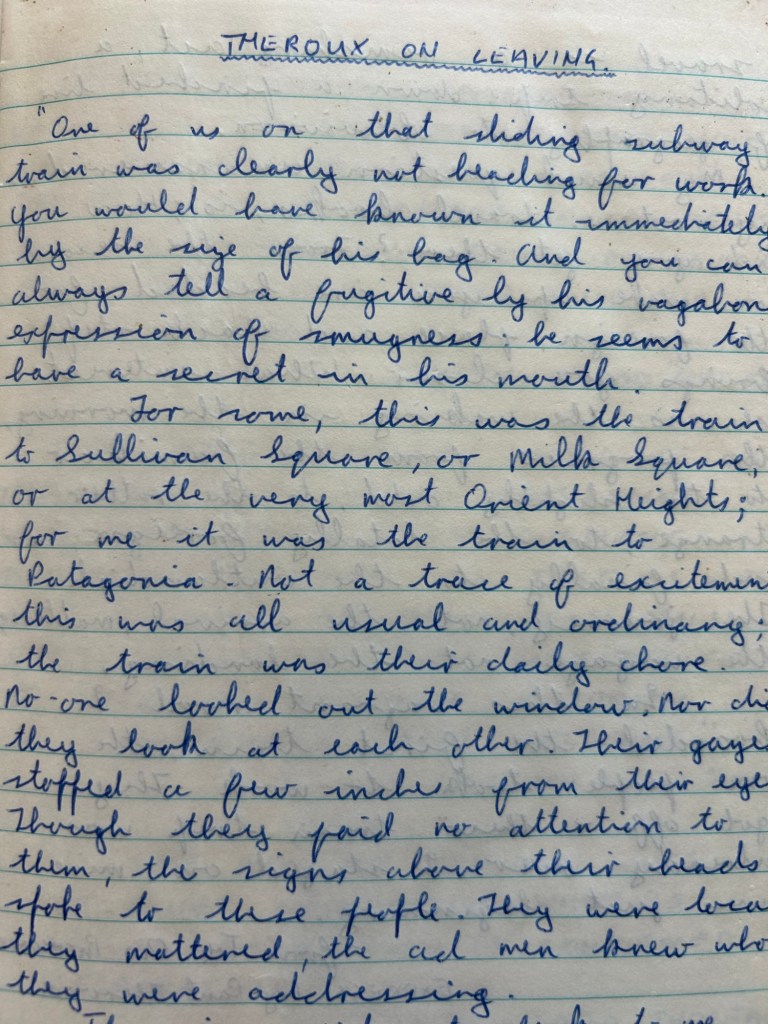
THEROUX ON LEAVING
One of us on that sliding subway train was clearly not heading for work. You could have known it immediately by the size of his bag, and you can also always tell a fugitive by his vagabond expression of smugness. He seems to have a secret in his mouth. For some, this was the train to Sullivan Square or Milk Square or at the very most, Orient Heights. For me, it was a train to Patagonia.
Not a trace of excitement. This was all usual and ordinary. The train was their daily chore. No one looked out the windows, nor did they look at each other. Their gazes stopped a few inches from their eyes. Though they paid no attention to them, the signs above their heads spoke to these people. They were local, they mattered, and the ad men knew who they were addressing. The signs did not speak to me. They were local matters, but I was leaving this morning, and when you are leaving, the promises in adverts are ineffectual.
Travel is a vanishing act, a solitary trip down a pinched line of geography to oblivion. My usual question, unanswered by most travel books, is, how did you get there? From the second you wake up, you are headed for the foreign place, and each step brings you closer. What interests me is the waking in the morning, the progress from the familiar to the slightly odd, to the rather strange, to the totally foreign, and finally, to the outlandish. The journey, not the arrival matters. The voyage, not the landing.
In this vagrant mood, I boarded the first train, the one people took to work. They got off. Their train trip was already over. I stayed on. Mine was just beginning.
– From The Old Patagonian Express by Paul Thoreaux.
These are some quotes that I wrote in my diary from Joseph Conrad’s “Lord Jim”:
“There is such a magnificent vagueness in the expectations that had driven each of us to sea, such a glorious indefiniteness, such a beautiful greed of adventures that are their own and only reward.”
“It’s extraordinary how we go through life with our eyes half shut, with dull ears, with dormant thoughts. Perhaps it’s just as well, and it may be that it is this very dullness that makes life to the incalculable majority so supportive and welcome.”
This quote from Henry David Thoreau’s book Walden: “The mass of men live lives of quiet desperation. What is called resignation is confirmed desperation.”


 CurseOfTheTraveller