It is our fourth day in Iran, and it seems that we are beginning to get the hang of making our way around the city. We are up early, 7:15 AM, we walk up to Maidan-i-Imam Khomeini, where we catch a bus up to Maidan Ferdowsi. From there, a shared taxi takes us for five hundred Rials up to Khayabūn Mothandari, where we can easily walk up to the New Zealand embassy.
Inside, we are given a warm welcome and meet the second secretary, Simon Tucker, who chats to us about life as an expat in Iran and about our travel plans. The letters of introduction for a Pakistani consul take about forty-five minutes to prepare, but we are happy to wait in the cool office, reading old copies of The Dominion and sipping a cup of coffee each.
Back out on the street, we take another shared taxi down to Ferdozi Street and walk slowly down to Maidūn-é Imam Khomeini, stopping along the way for a cold drink and a sandwich. I give our leftovers to a small boy who comes to the door of the restaurant begging. Later on, out on the street, I see him again, a forlorn little shape peering wistfully at some toys in a shop window. Unfortunately, he sees us and grabs my shirt sleeve, following along, desperately repeating attempts to shake him off. Eventually, a burly shopkeeper shoes him away.
We toy briefly with some of the money changers along the way, but none of them offer good rates, so we do not do business. Later on, down on Nasil Khusro Street, I buy a pair of Shalwar Kurdi pants for R8,500. They are much cooler and better than jeans.
Our friend Mohamed calls for us at three in the afternoon. We’ve just finished having some chai, and offer him some, but he is hot from walking and takes a glass of water instead. We leave the mossafakhuné [café] and walk up to Khomeini Square. The sun scorches down from a sky turned brown by the fetid breath of the city. It takes several minutes to find a shared taxi going the right way, but soon we are speeding up Ferdosi Street to Meidūn-e Ferdosi. From there, we take a bus along to a park near the two museums that we are going to visit with them. Walking through the park, some dirty grey and black birds hop about in front of us. They are called Kalod and appear similar to magpies or crows. The park is very well-kept, and beautiful weeping willows dot the manicured lawn.
At the centre of the park, we pause while I photograph the Alborz Mountains through the spray of some fountains. A man asks us jokingly if we want to photograph two beautiful girls who are seated on a bench. I take their photo with Linda beside them and promise to send them a copy. The younger of the two asks for us to be pen pals, and we promise to oblige her when we return to New Zealand.
We first go to the Carpet Museum of Iran, which although at first didn’t sound very enthralling, is in fact very good, with some beautiful examples of Persian carpet and Persian artwork. After the Carpet Museum, we visit an international exhibition of photography at the Fine Arts Museum. There are some very good photographs there, and also a lot which range from the strange to the downright bizarre.
Towards the end of the display, we are approached by two women who interview us about the expedition for a local newspaper, i.e., propaganda broadsheet. I offer glowing praise for the designs of the exhibition and comment favourably on the calibre of the artists. She is surprised when I say that it is hard to understand what inspired some of the pieces. “You can’t understand the Iranian ones,” she exclaims as if just the fact that they are Iranian makes them perfect.
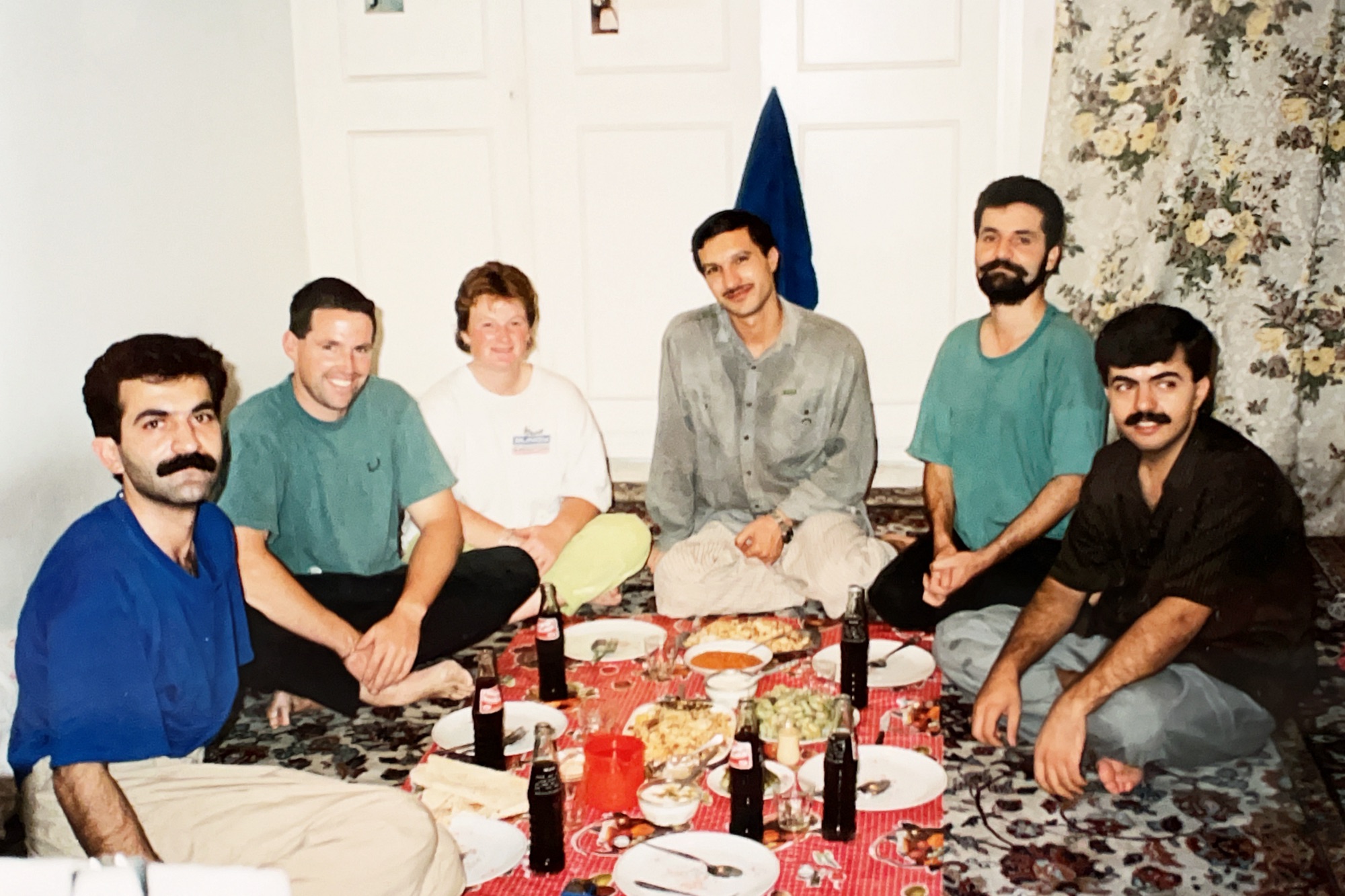
The journey to Mohammed and Shahrab’s office is long and hot, but we are given a very friendly welcome by their colleagues, who are all well-educated and united by their dislike of the Mullahs’ regime in Iran. We spend several hours at the office, drinking tea, eating cakes, and talking, then take a taxi to the house of Mohammed, Sahab and his brother Kamvar. They live in a quiet street in a two-room apartment consisting of a kitchen and a living room. There is no furniture, which is typical of Persian houses, and against one wall stands an entertainment centre with a TV, two video players, and a stereo.
We sit on the floor and watch two of the films that Mohammed and Shahab have made, one about a young shepherd boy and one about an old man who used to be a photographer. Both are very good films, although the constraints of budget are apparent in the quality of the prints.
We eat, the meal communal and eaten sitting on the floor. Rice, tomatoes, some meat, yoghurt, and bread. The conversation flows as we eat. It is very civilised. After the meal, we watch another film: a short animated story called The Sun at Night. Both Mohamed and Shahab are keen to make a film overseas, and we promise to find out information about film festivals and other avenues that might be open to them in New Zealand or in the United Kingdom. As always, it is depressing to meet talented and intelligent people caught up in Neanderthal political systems that seek to constrain individual talent within repressive and unproductive rules.
We sleep the night on mats unrolled on the floor.

 CurseOfTheTraveller