Back at the Pakistani embassy at three-thirty, there is already a queue of people waiting outside. At three-forty, the doors open and I push and shove, along with everyone else, to the small window where the passports are handed over. The cost for both visas is a mere R4,750, a substantial saving on the sixteen pounds it costs in London for the same visa. Our stated purpose of visiting is “Sightseeing”: the first time I’ve seen that written on a visa.


Twenty minutes later, we are speeding down Azadi Street towards the bus station. In the taxi, a young man speaks to us in English for a few minutes. When he gets out, he pays our fare for us. The generosity of Persians defies belief. Gradually, we come to the conclusion that there are two sorts of people in this country: Persians and Iranians. Iranians are the bearded men with short hair and angry expressions that follow the mullahs and screech, death to America, as they pound their heads. Persians, on the other hand, are gentle, cultivated, and intelligent people who want nothing more than normality to return to their country. They are often clean-shaven and have good dress sense, hold hands with their girlfriends, and generally despise what Islam and the mullahs have done to Iran.
Next to the towering Azadi Square monument stands the Termināl-é Ghāb, the West Bus Terminal. It is a scene of utter chaos with hundreds of buses belonging to the seventeen bus cooperatives lined up beneath a searing sun. It takes a bit of time to find a bus company that operates a bus to Chalus on the Caspian Sea coast, but the seats are an economical T550 for two, which equates to one pound fifty, and the bus leaves on the five-hour journey at five p.m., half an hour away.
Close to departure time, we are still unable to find the bus going to Chalus, but, of course, one only has to look lost for a few minutes before someone offers to help, and an Iranian man who lives in Canada is soon helping us to find the correct bus, which is parked inexplicably behind the others.
We board and sit sweating inside until, after about ten minutes, the bus moves off out of the terminal and onto the freeway leading up out of the city. As we turn onto the freeway, we pass an ominous reminder of the almost constant state of readiness for a war that Iran maintains: a set of anti-aircraft guns atop a mound of earth keeping guard over the great city laid out beneath a pall of beige pollution below.
Above the road, to the right, tower the bare shoulders of the Alborz Mountains, gigantic ranges of twisted and shattered rock like the hearth of Hell and nearly as hot. The highway is a strand of jet black laid on brown earth. It winds around a huge spur running down from the mountains and crosses a fast-flowing river before entering the gorge from which the same river emerges.
Immediately, the mountain walls close in, hemming the jade waters of the river into a narrow gorge with only enough room for the river and the road. This is the Karaj River, which flows down from high in the mountains to lose itself in the desolate marches of the Dasht-e Kavir deserts. The water looks wonderfully inviting as it rushes in white and green torrents down the steep riverbed. The banks are crowded with trees — poplars, maples, and a host of other deciduous species — and the entire valley is wonderfully cool and shady after the baking heat of Tehran.
The valley is very deep, the sides impossibly steep and rocky, and I have to crane my neck to see the sky, which is an achingly beautiful shade of blue. Each turn of the road, and there are many, brings an exquisite new vista. The valley narrows, then widens, then narrows again. Then the road begins a twisting ascent of the valley wall until the river is far below. We pass through a long tunnel, which is full of exhaust fumes. Linda and I both hold scarves over our mouths and noses until we emerge. There is a police checkpoint, which is cursory and fast. Then we are traveling along the shore of Lake Amir Kabir.

The scenery is stunning. The lake is a deep turquoise colour, highlighted by the beige of the rocky mountainsides, which fall sheer to the water. Water skiing is a popular pastime here, and the lake is abuzz with speedboats pulling skiers, most of whom are very competent. The lake is about ten kilometres long, gradually narrowing and becoming shallower, with the colour of the water reflecting this change as it slowly turns to pale green.
At the head of the lake, the river crosses a long area of silt left by the lake as it falls from its winter to its summer levels. We enter another tunnel. This one is more of a passage than a road tunnel, its sides only a meter from each side of the bus, and its air putrid with exhaust. The tunnel emerges at a pass, the top of the road, which immediately begins its steep descent from the heights of the tortured mountains of rock to the valley below, now filled with thick mist. Entering the mist, the world completely disappears and soon darkness begins to fall, hastened in its arrival by the mist, which seems to soak up light like a sponge.
We stop for a meal break halfway down the mountain at a small village shrouded in mist, which is lit up by the glow of coloured neon and the headlights of passing vehicles. The air is cold and damp and full of the smells of cooking meat and wood smoke. We eat some liver kebabs, for which the young cook tries to overcharge us, but an Iranian man steps in and tells him what appears to be, “fuck off.” For the remainder of the break, we hear the words of Engelistān and Zélānd-é Nó, so presumably people are discussing the attempted rip-off.
The rest of the journey passes in darkness on wet roads, half in and half out of sleep. At one point, the driver misses a hairpin bend and slides to a halt above a vertical drop. There is much tutting from passengers, and the driver becomes more sedate (he is actually quite a good driver anyway) until we reach the bottom of the descent.
A surprising aspect of the drive is the apparent annoyance that a lone smoker causes. Most buses in the East are chambers full of nicotine and tar but judging by the amount of tut-tutting that the smell of one cigarette causes, Iranians don’t approve of smoking on buses. We reach Chalūs at ten-fifteen p.m., and some people disembark. Then we carry on to Nōshahr, where a man who speaks good English shows us the way to the Hōtel-é Shalizar, or, as its garish yellow sign above a mock Doric entrance says, “HO-EL S-L-ZAR.
A curt “No” greets our inquiries about a room, so I run after the man who speaks English and ask if there is another place to stay. After a bit of searching, during which time this helpful man, who has several degrees in Business Administration, takes us in a taxi and we find a good place to stay. The hotel (whose name I can’t fathom even after a full day in residence) is clean and spacious, has wonderful hot showers, and is cheap at an economical 8,000 Rials for two. The young man who runs the place is himself a traveller and has visited many countries in Eastern Europe and the Middle East. After showers, we retire thankfully to bed.
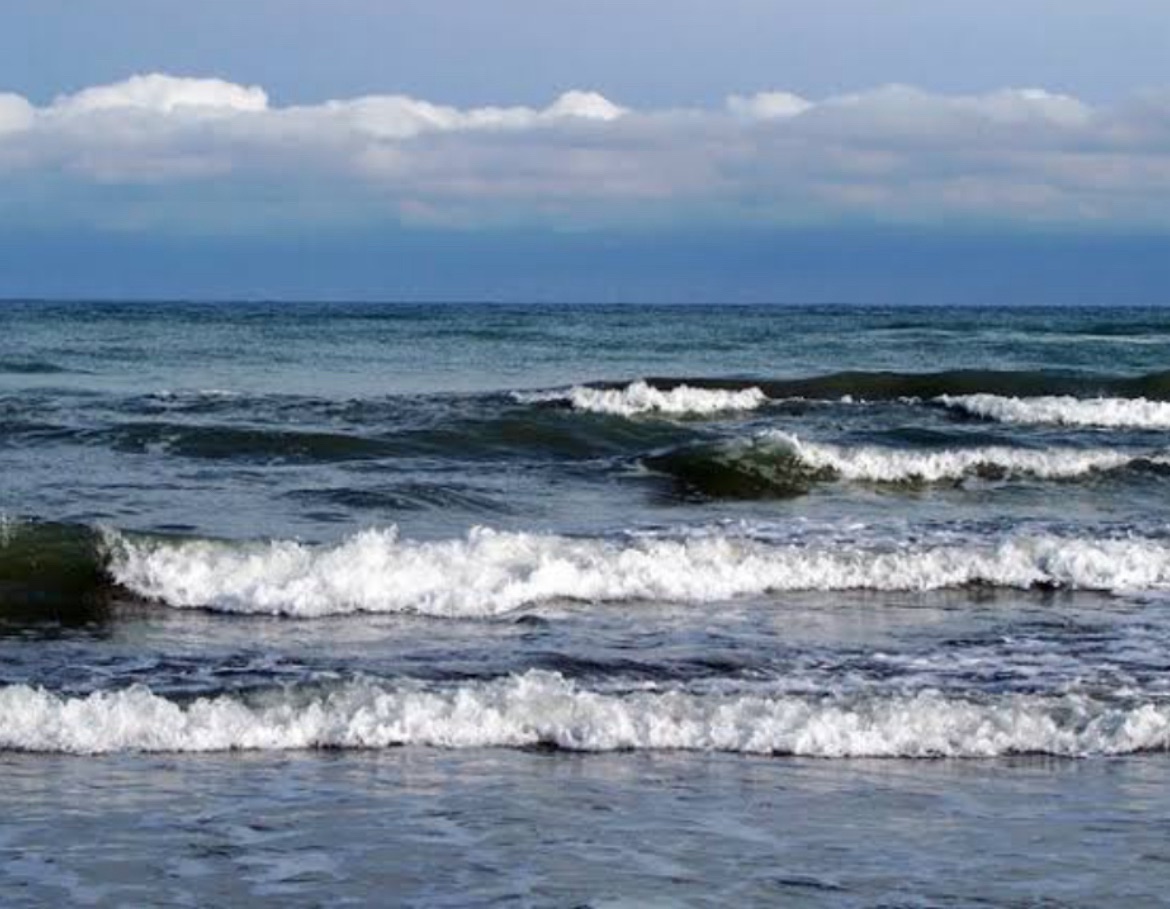
Waking late, I go out for a short walk. Arriving in darkness, we hadn’t realized how close we were to the Caspian Sea shore. It is literally only fifty meters from the hotel, and I walk across the road and down through a yard to the rocky beach where the waters of the sea crash onto the land. In recent months, the level of the Caspian Sea has risen dramatically, and the water is slowly eating into the coastline, already threatening the buildings along the shoreline, several of which are damaged. The stumps of trees protruding from the turbulent surf are testimony to the increasing level of the sea. But oh, what a sight, this graceful and warm ocean of blues and greens.
(As I write this passage, I am listening to Pachelbel’s Canon in D, and it could have been written about the Caspian Sea.)
The sky is turbulent; an array of greys and blacks descending to the horizon, where the dark line, that unreachable point where reality ends and fantasy begins, lies. Beyond lie the lands of Mother Russia, of Azerbaijan and Turkmenistan. The sea booms and crashes. The water is warm and clean, and the sky above is framed by the leafless branches of a long-dead tree, its life drowned by the pounding water.
Linda is still asleep when I return to the hotel, so I do some washing, then settle down to write. Later on, we walk up to a chāykhūne and eat some sweet cakes while watching the activity on the street. Like any seaside resort, Nōshahr has a good supply of shops selling beach tat, or, as the Lonely Planet book puts it: “inflatable toys at inflated prices and dubious souvenirs, which can at least be described as defāvī: rustic, unstylish, or kitsch.”
After a walk along the beach, we find a most bizarre shop: a restaurant called McDonald’s, complete with a set of golden arches and selling delicious rotisserie chicken. We stuff our faces!! We sleep most of the afternoon, venturing out into a drizzly evening for a meal of chelo kebabi.

 CurseOfTheTraveller