Our morning’s efforts comprise a shopping trip. At large in the bazaar at 9.30 after an expensive breakfast at the Hotel Poroski, we begin our search for some appropriate souvenirs of our stay in Iran. The bazaar is large and colourful, and completely lacking in the annoying pressure of merchants that are the telltale sign of a market corrupted by tourists.
Entering the main gate, we walk first past carpet shops, bedecked with a huge range of carpets, high quality and low. Then there is a brassware section, with stacks of brass and steelware, gleaming with a soft burnished glow. Further on into the bazaar, the shops sell everyday goods of life: cutlery, cooking pots, furniture, crockery and glassware, household goods, soap, pot scrubbers and plastic containers, and, most wondrous of all, spice.
The spice sellers have piles of turmeric, henna, pepper, and chilli heaped up in containers or in muslin bags. The smell is wonderful. We spend 10 minutes haggling with a spice merchant over the price of his 4.5-gram packets of saffron. But despite our offer to buy 30 packets, he refuses to budge from his 3,500 Rials price per bag. Back out in the main square, we browse along the rows of souvenir shops, finally buying two hand-painted copper vases and a small pipe for 39,000 Rials, along with six hand-painted tiles for 9,000 Rials.
I change money with one of the many street money changers, and we go back into the bazaar and buy 30 packets of saffron from another spice stall, which cost us around US$50.
Later in the day, loaded down with stuff to post home, we are back in the square. It is mid-afternoon, hot, and most of the shops are closed for siesta. A man tells us that the post office will be shut and that we should go there in the morning. He offers to show us one of the caravanserais in the bazaar, where Shah Abbas kept his polo horses. We agree, and follow the man, who is a teacher of English and Persian literature, into the bazaar, now empty of people and cool. As we walk, I ask him about Rustam Ferdowsi’s superhero, and he tells us a story.
Rostam married a princess, Tahmina, and they had a son together. But somehow, the son was stolen by Greek soldiers and taken to Greece, where he grew up to become the strongest man in the Greek empire. Eventually, he came to hear of Rostam and travelled to Persia to challenge him to a duel to the death for ultimate supremacy. They fought and Rostam got the upper hand, but said to his young opponent: “you are the best I have ever fought, stop fighting because I do not want to kill you.”
But the younger man insisted on fighting to the death, so they fought again and Rostam killed him. As he withdrew his dagger he saw an armband on the young man’s arm. Rostam had given the armband to Tahmina to put on their child when he was a boy, and he realized that he had just killed his own son.
The moral of the story is about humility and how being too ambitious can have bad consequences. Scholars also theorise that the story is a metaphor for Persia itself and how the empire has repeatedly been brought down by the hubris of its leaders.
We pass through a narrow doorway set into a whitewashed wall, into a small dark room with a vaulted ceiling through which penetrates a bright shaft of light. The room is an old spice grinding shop. In the middle of the floor, there is a round stone platform about half a metre high, with an oblong grinding stone connected to a pivot at its centre. Surrounding the grinding platform there is a channel in the floor around which a camel would have walked, turning the grindstone. The grindstone itself has now been replaced by an electric mill, which we can hear churning away in the next room. The air is heavy with the smell of turmeric and coriander and pepper.
Our guide tells us that the grinding room dates from the reign of Shah Abbas and is about 400 years old. There are piles of sacks full of spice in the dark recesses of the room. The miller places a ladder against the wall outside his shop. I climb up onto the mud-covered roof of the bizarre. The domed skylights beneath the blue sky and the searing sunlight make an interesting picture. As I clamber down the steps back to the miller’s yard, I pause and photograph of cluster of chadors hanging in a backyard to dry.
The caravanserai itself is uninspiring and cluttered with rubbish, but beyond, we are taken to see a tradesman making a hand-printed tablecloth. We are unsure if this whole trip hasn’t just been a scam to entice us into the shop, but in the event, the tablecloths are very beautiful, and we buy one for 35,000 Rials. So, in the end, while we’d set off to post stuff home, we end up carrying it all back to the hotel along with another item.

In the evening, we go back to the square to watch the sun set on the great mosque. We climb the dusty steps of the Shah’s governmental seat, the Kākh-é-Ali-Ghāipū. From the huge pavilion, where Shah Abbas would watch polo matches in the Great Square, we watch the sun slowly set on the Masjid-é-Imam Khomeini. Away in the darkness, beyond the edge of the city, the ochre ramparts of a range of hills mirror the skyline of the mosque.
Further up in the palace, reached by another set of dusty stone stairs, the music room is a picture of faded glory. Its labyrinth of rooms with intricate stalactite mouldings are devoid of colour save for a uniformly dusty red. All of the surface decoration is gone. The sun has set, metaphorically as well as physically, on the glorious Abbas dynasty: “HOW SULTAN AFTER SULTAN, WITH HIS POMP, ABODE HIS HOUR OR TWO AND WENT HIS WAY.”
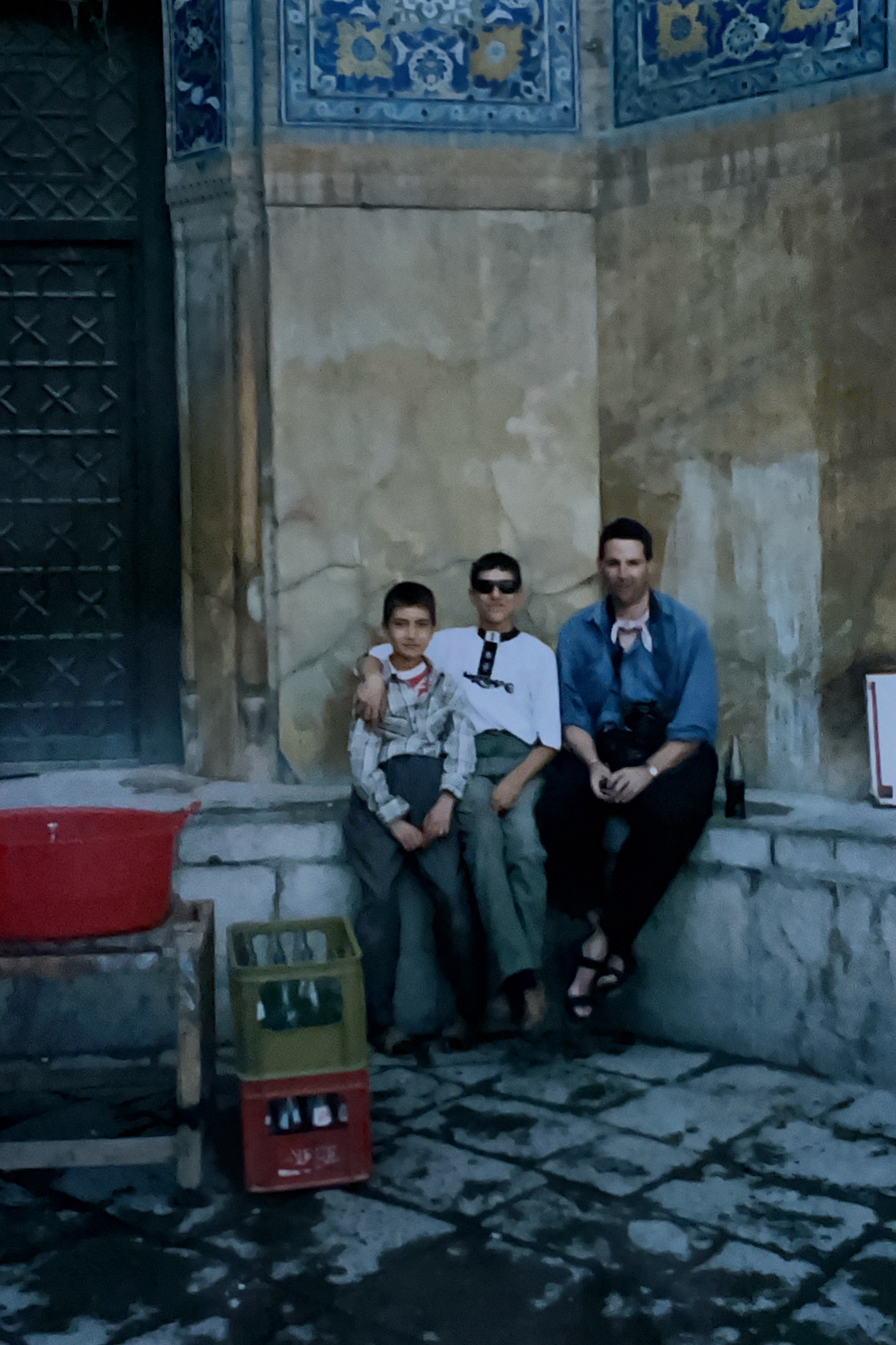
We buy cold drinks from two young capitalist sharks we had befriended outside the Masjid-é-Emān and sit watching the activity outside the mosque. At 7.45, with the sky a deep, dark, velvety blue, lights are switched on to illuminate the ornate portal of the building. The tiles take on a deep turquoise shade, alternating shadow with sheen. From twin loudspeakers comes the voice of the Mazeen: Allahu Akbar, La illa illa Allah, Mohammad Rasul Allah. (God is great, there is no god but Allah, and Muhammad is his prophet.)
We walk up the west side of the square, pausing at a shop to buy a small vase for Helen [Linda’s mum] as a present. Lights are switched on to illuminate the dome of the mosque of Sheikh Latfollāh. The sky behind is indigo and soft, the pale colours of the mosque’s dome perfectly proportioned in relation to the rest of the building. There are many people in the square, picnicking, shopping, and just strolling. A small horse and cart that takes people for rides around the square is busy. The clip-clopping of the horse’s hooves and the jingling of their bells is reminiscent of a Scandinavian winter scene: sleigh bells in the snow.

 CurseOfTheTraveller