Hard metal bars at our backs. No leg room. Leaving Isfahan, we passed through a wide area of farmland. Mud-brick farm compounds, fields of hay harvested green and dried within the compounds, flocks of sheep, stubble burnt black against the ground. Along the road, plantations of conifers and rows of plants with bright red flowers.
Beyond the plain, jagged, chess-piece mountains. Summits like teeth. Flanks scratched by ancient glaciers. We passed the Iran Soya Protein Company factory backdropped by a mountain of beige rock. In the depression at the foot of the mountains, the oases continue green and fertile. Above stands the mountains, unbelievably dry, arid, and bare, like brown crockery stacked up and then smashed.
The road brushes the foot of the mountains, then turns hard left, crossing the oasis through fields of ripening corn and plots of rice irrigated with channels. On the oasis margin, the smoke from brick kiln fires smudge the sky. Farmland gives way to desert. The surface of the desert is flat and crusty, and dotted with arid-looking shrubs. In places, patches of green are a telltale sign of water close to the surface.
Half an hour out from Isfahan, the bus stops for fuel at a mud-brick town in a small oasis. The stop gives me time to describe the events of yesterday.
*****
At the post office early in the morning, we discover that postage rates from Iran are prohibitive. 62,000 Rials (20 quid) or twice what we paid for everything. We send only the video of Shahab and Mohammed’s movies, and return to the hotel with the rest. They can be posted in Pakistan for far less. After a break, we walk up to the Jamé-é Masjid. It is a long, hot walk along a busy street, then up through the bazaar, where Thursday shoppers shuffle and dawdle, making passage for the burning jahāngard [foreigners] frustratingly slow.
*****
The desert we are passing through is neither the sand of the great Erg Occidental nor the rock of the Hoggar Mountains. It is more a desert of gravel and dried mud. In the distance, a range of mountains sweep down to the plain. Stunted grasses grow. The scene is not too dissimilar to the Whalesback Flat, except there are no sheep grazing here and J.P. Kerr isn’t prowling around in his little Datsun truck.1
1 This is a reference to the high country sheep station that I worked on in the early eighties. It was managed by a fellow called JP Kerr and had a large flat plain called The Whalesback.
*****
We emerge from the gloom of the bazaar into the courtyard in front of the mosque just in time to join a party of German tourists. A ticket booth had appeared since last time I was there, but we joined the group and got in for free.
The Germans, in their severe Teutonic clothes, jabber constantly, ruining the quiet, empty atmosphere of the mosque’s cloisters. I hurriedly shoot off 12 shots to finish the black and white film that is in the camera, and then we leave. On the way out, the ticket collector asks to see our ticket stubs and I tell him we threw them in the rubbish bin, so we don’t have to pay.
We snooze all afternoon, as does most of Isfahan. At 5.30, Linda, Masayuki, and I walk up to the main square. Inside the Masjid-é Imam, there is a steady stream of Iranian visitors taking photos and making noise. A few people pray in the courtyard, mumbling prayers and genuflecting in the direction of Mecca.
The pool of water at the centre of the courtyard ripples slightly but still provides a wonderful reflection of the mosque’s tilework. Slowly, the shadow of the central minarets creep across the wall of the Merab, and the sunlight fades from the courtyard, remaining only on the western side of the great dome. Prayers are to be said shortly, and the caretakers are shooing people out. Masaiyuki and I climb up a dark stairwell emerging on the roof of one of the eivans. Straight away, we are told to leave. It is forbidden for unauthorised people to go up to the roof of the mosque.
We leave and sit out on the cool grass at the centre of the square. Darkness falls and we take some photos of the illuminated mosques and of each other. It is a wonderful place. All it needs to complete the picture are a few cans of beer and a joint.
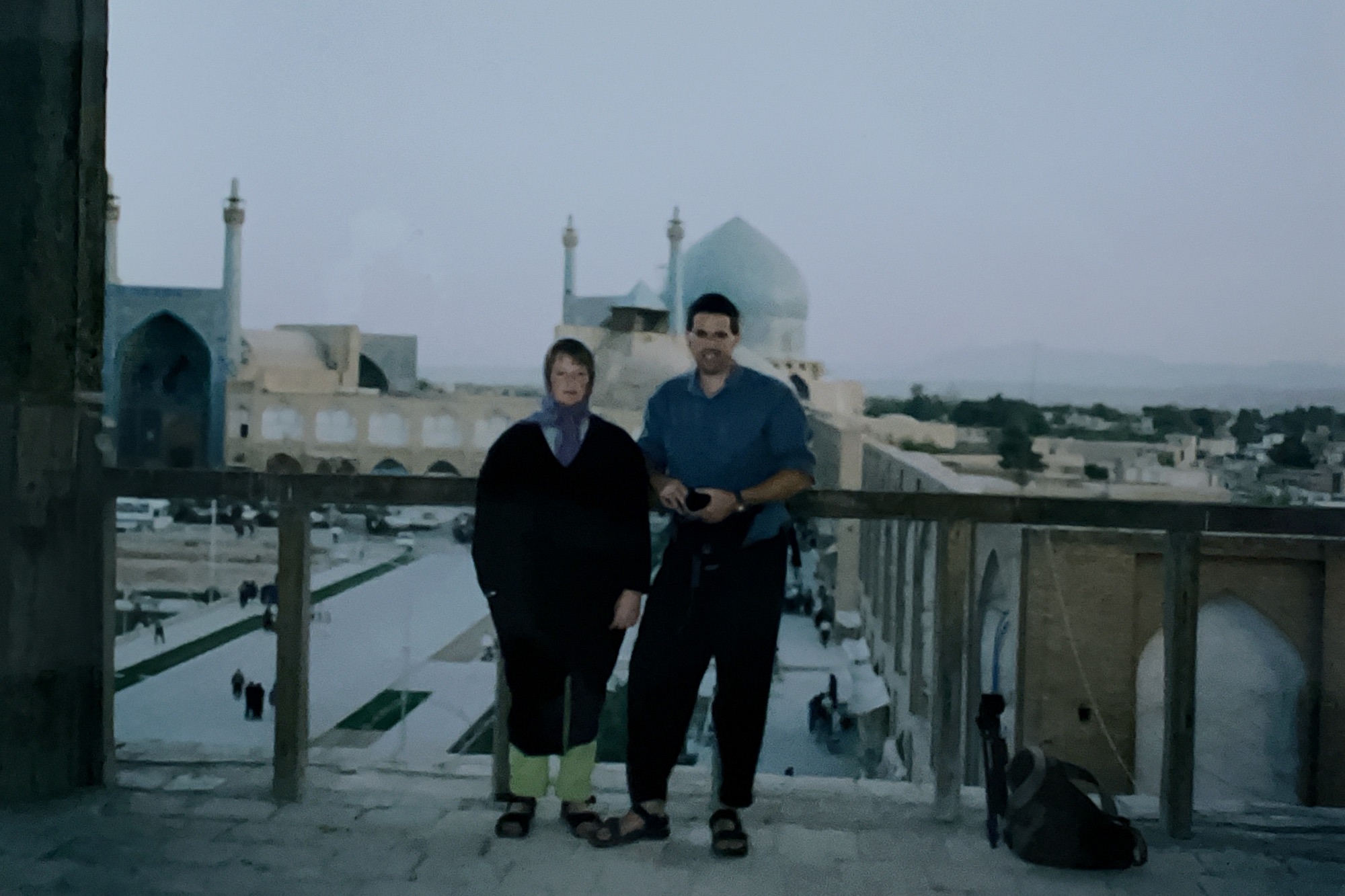
To complete the evening, we retire to the Nobahār restaurant for chicken and rice. There is a good cross-section of tourists there and we pass a pleasant two hours chatting about travelling and far-off places. Sam, a Canadian who lives in Berlin, has travelled widely in India, Morocco, and South America. A bloke from Manchester and his Spanish girlfriend are riding an Enfield motorcycle from India back to the UK. Next year, they want to fly a microlight from Canada to Chile. Back at the hotel, Masayuki brings tea and we talk late into the night about Darjeeling, Bangladesh, and spice.
*****
We are quite lucky to be on this bus. Arriving at the Esfahan bus terminal at 8am, we were told that the only bus to Yazd is already full, but a man helps us to get onto the bus bound for Zahidan instead. We pay him 8,000 Rials for letting us on: twice the fare to Yazd, but better than another night in Esfahan.
HOTEL ANYA, 7.30pm. Arriving in Yazd at 4pm, we found the two hotels mentioned in the book to be full, but a boy on a bike shows us to the Hotel Anya, a pleasant place with a quiet courtyard with roses and a fountain, where we stay for the princely sum of 4,000 Rials for two.

 CurseOfTheTraveller