At 6.20am we are awake, partly because of the beeping of the alarm and partly by the noisy clearing of throats and noses coming from the toilets next door. We are sharing the hotel with a group of old men, all of similar age and all with remarkably similar features, as if they all shared a common father or mother.
Outside, a cool desert wind blows out of the west as we walk into town. There aren’t many taxis about at this hour, but eventually one comes along and takes us down to the entrance to the old city, the Arg-e Bam, set into a crenellated mud wall that stretches from a corner watchtower off to the right, to be swallowed up by the dense groves of date trees.
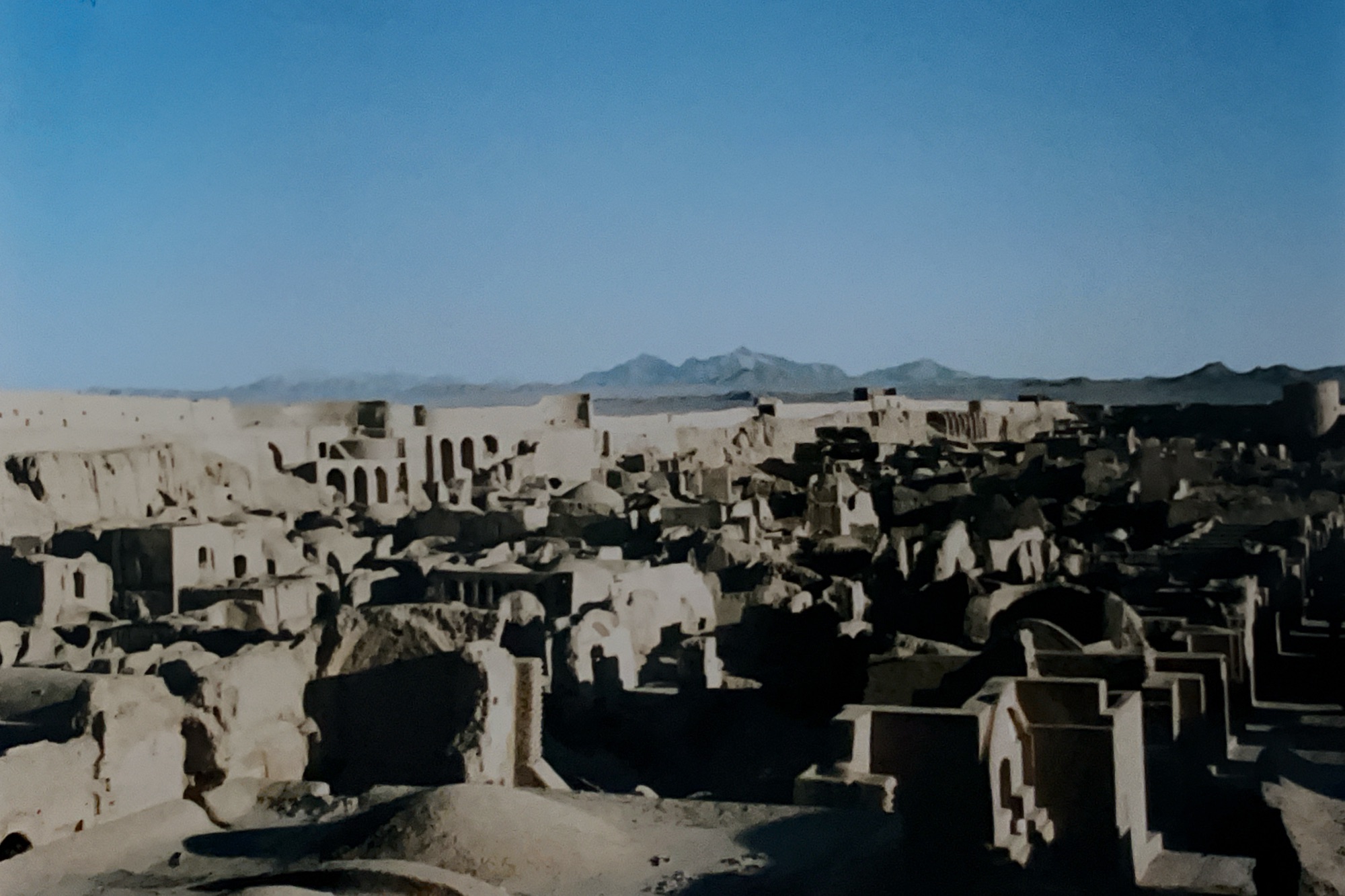
The entrance fees are 300 Rials per person, plus 900 Rials per camera. We tell the guard that we only have one camera. Following a narrow cobbled path between the high walls, we emerge at the edge of the old city. It has melted. Like sugar mice in the rain, the walls and rooftops and the archways are returning to the desert, each season’s rain melting the city a little bit more.
We climb some stone steps to a vantage point on the outer wall, which stretches unbroken around the entire perimeter of the city, culminating in the citadel, which stands resolute and impregnable on the north side of the old city. The sky is deep blue and the low angle of the sun creates a complex interplay of shadow and shade amongst the contorted ruins of the city. We walk along a cobbled path through the ruined houses, stables, bazaars and mosques. A few shambling workmen push wheelbarrows along and shovel rubble in a desultory fashion.

Work is under way to rebuild some, or possibly all, the ruins of Bam. And despite the apparent sloth of the workmen, a good job is being made. Perhaps one day people will return to live with the walls of this great, empty ruin.
[Author’s note: A large earthquake in 2003 almost completely flattened the Arg-e Bam. The Iranian government has pledged to completely rebuild the citadel and surrounding city.]
The Citadel seems immense, towering over us as we stand at its entrance portal. It is built upon a mound of rock, its walls rising sheer for 20 to 30 metres, every metre of its length crenellated with gunports and sally points. Passing through an inner courtyard — the Artillery Yard — we enter a narrow series of cobbled passages, which lead ultimately to the Watchtower at the very heart of the Citadel.
Standing on the narrow platform at the top of the tower, the view is stupendous. From the contortions of the ruined city, the walls, the new town, and the oasis beyond, to the desert beyond, stretching boundless and bare, to the rugged mountain ranges beyond, devoid of soil and vegetation, and looking for all the world, like the planet before life evolved.
Below the eastern ramparts of the Citadel stand the remains of other walls, further out from the oasis. They are sad remains. The years have reduced them to mounds of earth, ploughed into the fields, eroded by wind and water, mixed with the remains of the men who built them, dust to dust.
A cool wind whispers about the Citadel, but nothing else moves. Despite its beauty, it is also a desolate place, a dead place. We leave the high point of the Citadel and explore amongst the ruins. The occasional workman peers down from a rooftop or rides past on a donkey.
As we walk out of the mud-brick city via a tract of soil churned to powder by tractors, I remember the words of Henry David Thoreau: “when a man dies he kicks the dust.” The dust of the people who built this place have been scattered, blown by the wind, and washed away in the rain.
The town of Bam is uninteresting; the people in a state of complete torpor. We ride a taxi back to the hotel and hibernate for the rest of the day. In the evening, we eat with two other travellers, a Dutchman called Harry and an Irishman called Tom. I wonder what happened to Dick? After the meal, we all sit outside talking. Five other dusty travellers, four Aussies and a Swiss, arrive from the border. We sit talking until nearly midnight, out in the cool desert night.

 CurseOfTheTraveller