Again, we are up early. I have a quick shower and the water is very hot. We have to wake someone to let us out of the hotel whose front door is padlocked shut. What if there was a fire? The only people in the bazaar at this hour — 6AM — are two green-uniformed policemen armed with AK-47s. We walk out to the street and catch a small pickup out to the terminal. As we alight, a man comes up to us, offering to take us to the border for 20,000 Rials. Thus, of course, is a fortune. But after searching around all of the bus companies, none of whom have buses going to the border, we decide to accept his offer.
We stow our packs in the back of his Toyota pickup truck and drive out of town. A sign says “Mirjave, 95 KM.” The road is a good one: two lanes of smooth asphalt stretching ahead of us into the rising sun. There is very little traffic. The morning sun, just a few degrees above the horizon, divests the landscape with a deep effect of linear perspective: row after row of mountains rolling back into the into the haze, each row a lighter shade of blue/grey.
We pass through a checkpoint. The policeman asks for our passports. He examines them with elaborate care. But I notice he is holding them upside down. The road continues on through the desert. I asked Josef, our driver, if anyone lives out here. He replies: “no, there is nothing but thousands of kilometres of empty desert.” There is another checkpoint. A lot of guns: AK-47s and heavy machine guns.
*****
It is 5:30 PM and we are far out in the desert. Since leaving Taftan on the “11:30 AM” bus at 1:30 PM, we have bounced across about 200 kilometres of road. The desert we have passed through is a howling wilderness of heat and dust. In places, drifts of sand (like the ones I remember in the Grand Erg Occidental of Morocco) have drifted across the road. Buildings lie abandoned, their roofs gone, sand piling up against their walls. Out in the distance, huge mountains of yellow sand float in quicksilver mirage lakes. I cannot write anymore in this jolting bus.
The afternoon sun is unpleasantly hot, but as afternoon draws into evening, the heat dissipates from the air and the day becomes mellow and bearable again.
*****
A few kilometres beyond the second choice checkpoint, a Toyota Hilux is driving up the centre line, its lights flashing. The vehicle ahead of us stops. On the back of the truck are several men, turbaned and brandishing AK-47s. At first I think “dacoits” [robbers] but they are actually police. One of them waves his hand at Josef, who mistakes this as a signal to pass by, and does so. Behind us, there is a lot of shouting and Josef stops straight away. One of the turbaned men flings the door of the truck open and points his Kalashnikov into the cab. Although the gun isn’t actually pointed at us, the intent is clear. I remember the feel of an AK47 as it is fired: the sensation of deadliness that these weapons impart. It is a scary moment.
The police have Josef out of the truck and are shouting at him. The officer in charge has the Hezbollahi look of a revolutionary. He’s ranting in Farsi and pushes Josepf hard against the truck, then stalks back to their vehicle. In the rear vision mirror I can see Josef pleading with him that it is just a misunderstanding. These men are out of control, drunk with power that a gun gives a man of lesser intelligence. At night they will be openly abetting the smuggling that goes on across the Iran-Pakistan border. They are the worst result of revolutions.
Eventually, we are allowed to go. There are several more checkpoints, but all are quite relaxed. We reach the border at 7:30 AM.
There are four foreigners already at the border and a busload of Haj pilgrims camped out in the dusty compound. Two of the foreigners are from South America; two are well-to-do Pakistanis returning from a holiday in Turkey. The border opens at 8:00 AM. We are all first in line but a mob of wizened old hags are soon clamouring around us, pushing and shoving and complaining. We are stamped out of Iran without fuss.
At customs, we have to wait for half an hour while some obnoxious fuck finishes his glass of tea. His subsequent inspection of our packs involves us unzipping them and zipping them up again. We walked the last 20 metres out of Iran, past walls painted with quotes from their beloved and crazed Imam Khomeini. It is some nonsense about the hand of the holy warrior striking down the enemy…et cetera, et cetera, et cetera. I remember reading somewhere how Iran broke off diplomatic relations with Turkey after a Turkish newspaper published a story about Kohmeini’s funeral. In it, the reporter said that the imam’s body, which fell out of its coffin amid the mass hysteria of mourners, was “dragged like a dog.” A fitting end for the man, I should have thought.
Beyond the last scowling picture of Khomeini, we step through an iron gate into Pakistan. Immigrant takes about 45 minutes. Then we walk over to customs who hardly spare us at glance as they are busy talking. The two Pakistani men have reserved us seats on the first bus to Quetta. I tell one of them, whose name is Kamran, that I have to go to the bank to change money. He takes me around the corner and we do a deal with some black market money changers. Banking, Pakistani style!
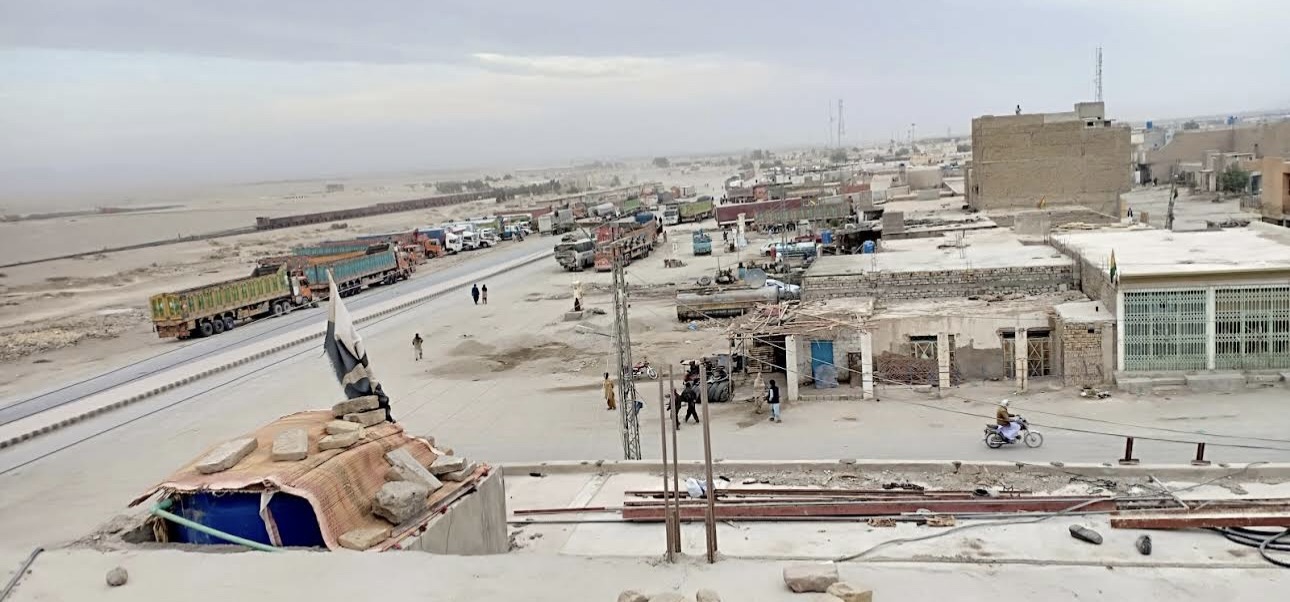
Taftan is, to quote Lonely Planet, a “flyblown den of smugglers.” Even the goats look as though they are engaged in something illegal. The wind blows dust and rubbish around amongst the adobe buildings. The air is heavy with the smell of exhaust and urine. We have a cold drink in a tiny dark restaurant, then find a shady place to wait.
*****
THE QUETTA CHILTERN EXPRESS – 5:30 PM. The train is sweeping down the eastern side of a river valley, cut deep into a landscape of brown layered gravel. The sides of the valley are intricately eroded into gullies, ravines, pinnacles, razor-edge cliffs and ridges. All of this detail is deftly highlighted by the sun, now at a low angle after its long crawl across the afternoon sky. In places the line passes through cuttings and tunnels, allowing a close look at the make up of the ground. It is a densely packed alluvial gravel mixed with boulders and is slightly tilted from the east.
Down the valley, a small river flows, allowing a few farmers to eke out a meagre living, growing crops and raising sheep and goats. Emerging from the valley, we cross the edge of a plain then enter another valley. The landscape here is very different. Sharp ridges of sandstone are thrust up at angles resembling the teeth of a saw. The rock is smooth reddish brown and shale-like. In the midst of this chaos of rock flows a sluggish river, its steel-blue water whipped into ripples by the hot wind, which has accompanied us all afternoon. We passed directly through this strange, serrated landscape via a series of short tunnels and emerge finally into the flat plains of eastern Baluchistan.
Directly outside the mountains there is a wide area of arable land watered by the river from the hills. Alongside the track, mud has dried up, cracked and curled until it resembles autumn leaves blown down by the first storm of October. At Narribank, there is a wide bridge built of girders across the river. The land here is fertile and closely farmed on all sides. The land is green. The sun shines almost horizontally, casting a delicate gold light across the earth. A three quarter moon hangs in the sky. Everywhere there is water and vegetation, a far cry from the barrenness we have crossed over the last two weeks.
At 6:30 PM we pull into Subi Junction for an evening meal and prayers. The station is a hive of activity: roti wallahs, chai wallahs, beggars, goats, policeman armed with ancient semi automatic rifles. Earlier on, I remember, some police had passed through the crowd through the train, casually looking for anything untoward. One of them had stickers that said “LOVE” on the butt of his battered old rifle.
Linda and I drink a bottle of Coke each, and I also have a cup of quite delicious chai. We wander up and down the platform looking at things and being looked at. The First Class Waiting and Retiring Rooms (Gentlemen only) are a little time warp from the Raj: oak furniture, ceiling fans and an old print of Quetta. The two men in the Inspector of Trains office are busily are busy inspecting the daily newspaper.
As we pull out of the station at 7:05 PM sharp, the western sky has once again donned its saffron robes and indigo darkness descends on the plains of eastern Baluchistan.
*****
In order to be sure that our packs are properly secured on the roof of the bus, I climb up and try to make the man in charge understand that if our packs fall off, he will be in deep shit. He seems happily unworried by this, and I spend half an hour helping to load gigantic bundles of smuggled goods onto the bus’s roof. Along with the South Americans — a Brazilian called Fred and his Peruvian girlfriend Betty — we retire to a shady porch, shooing away a couple of residents goats, to wait for the departure, which finally arrives at 1:30 PM.
The bus is jamed with passengers: wizened old men returning from the Haj and young Afghanis, blue eyed and fairheaded (one has a striking resemblance to Rusty Graham) illegal aliens begging the police to ignore them. There is a group of wild-eyed Baluchis accompanied by their wives. The woman are clothed in brightly-coloured saris and all are wearing nose studs. They perch in the backseats, bouncing in unison at each pothole.
The driver is a huge bear of a man, a Pathan, bearded and wearing a mountainous blue turban. He has brown teeth and a wide, mischievous grin. He drives like he looks: wildly. Each approaching vehicle on the narrow strip of asphalt as taken head on, the drivers of both vehicles only swerving to avoid collision at the very last second. I take some comfort watching these encounters from my aisle seat in the assumption that the driver doesn’t want to die and will stop short of actual contact.
There are numerous stops for praying and for chai. Some of the chai stalls are in the middle of great wilderness of desert and I wonder what they make their tea with. There certainly doesn’t appear to be any water. A final prayer stop has made at dusk. The western sky is the colour of a sadhu’s saffron robes and a hot wind blows out of the south-west. I surreptitiously watched three men praying lined up in a row, facing the place where the sun disappeared, which also happens to be the direction in which Mecca lies. From behind they are silhouetted by the orange sky. It would make a great photograph, but my camera, however, is out of film and in any case I can’t be bothered getting it from the bus.
The night is interminable, seeming to go on and on. The air becomes cold, the sky full of stars. At 2:00 AM we are stopped by yet another police checkpoint. They mean business this time. Most of the passengers on the bus have smuggled goods with them and the entire load is thrown down and inspected. The driver, who no doubt his his own supply of perquisites, is livid, shouting and arguing with the police without any fear of the guns they’re brandishing. I climb up onto the roof and make sure our gear is secure, then mill about with a few other passengers periodically being herded out of the way by the police.
Eventually the game becomes tiring and we 4 travellers get back into the bus and sleep. The police detain the bus until 6:00 AM. It takes another 3½ hours to reach Quetta and after getting our gear down from the roof of the bus we take a rickshaw to the Muslim Hotel.

 CurseOfTheTraveller