NB: The timeline of today’s entry jumps back and forth. Asterisks denote where flashbacks begin and end.
We allow ourselves a generous lie in this morning, reading a copy of the International Herald Cheap Tribune over cups of hot milky chai. Checkout at the hotel isn’t until 12 noon, so at five minutes to twelve, we pay for our room and eat a tasty meat curry in the restaurant before walking down to the station.
*****
THE QUETTA-CHILTERN EXPRESS, 11:00 AM, NEAR MULTAN
At dawn, the train is at Rajahpur Station. I disembark and wash at a tap then buy a cup of chai. It is most refreshing and I savour its sweet, milky taste. From Rajahpur, the line crosses an area of floodplain. Trees sprout from the water, and the occasional structure stands on a raised mound to the east. The sun rises from behind a curtain of haze and vegetation. It looks slightly oblong as if the bottom half is pushing up hard, anxious to get on with the day, while the top half has reservations about the whole idea. It is an angry orange colour. But soon it passes from bright yellow to white hot and the day is born.
We pass through a rich landscape of verdant foliage and healthy crops. Everywhere there is water, calm, reflective. It is a tropical landscape; an equatorial landscape. Flocks of white birds — egrets, perhaps — flit about like white butterflies fluttering over a cabbage patch. Sleek black buffalo ponderously graze, chewing each mouthful 52 times. The fluffy, white seedheads of rushes move to and fro in the breeze like the plumes of a Queen’s Own Guard Sergeant Major. From pools of water, bushes sprout, looking for all the world as if each is a submerged African witch doctor with only his head-dress showing.
Later on in the morning, we cross a wide, dusty riverbed, on both sides of which silted-up fields, wrecked buildings and tangled vegetation are evidence of a recent catastrophic flood. We stop at several small stations, each with a selection of wallahs selling chai, apples, cold drinks and hot food. I sample some puri: deep-fried dough containing potato and chillies. It is delicious.
With the heat of the day comes a grey dusty haze reducing the colours of the landscape to green and grey. Palm trees, like prehistoric cycads, wave in the hot breeze, which wrinkles the surfaces of pools of water lying about.
*****
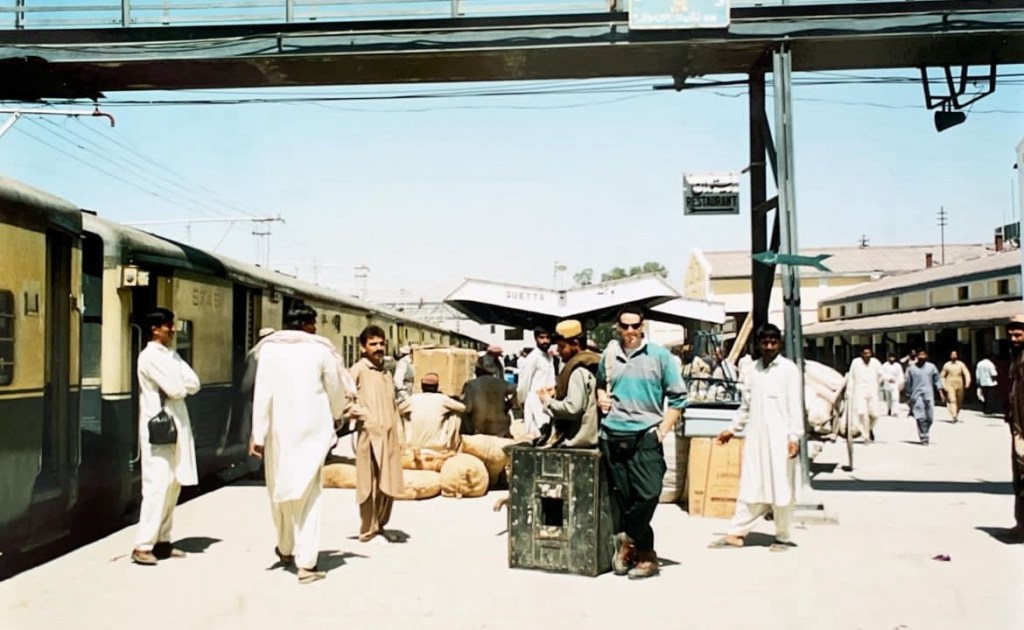
Quetta Station is as chaotic as every other railway station on the subcontinent. Boxes and crates are piled high on the platform and porters, looking rather splendid in their scarlet uniforms, dash back and forth with luggage and parcels. Our train, minus the locomotive, is already on Platform 1 and we locate our seats in carriage number one. We both have single-window seats. A godsend in Economy Class.
We wander about on the platform for a while. The air of the place is very colonial: dark rooms with polished wood and stacks of papers and files. Each room has a sign denoting which department resides there: Station Superintendent, Correspondent Clerk’s Office, Commercial Supervisor (Booking), VIP Lounge, Supervisor Trains, Assistant Station Master’s Office, Telegraph Office, and Divisional Paymaster’s Office.
The train pulls out of the station at precisely 2:00 PM, the scheduled time of departure. Rolling out of Quetta, we pass row after row of squalid adobe houses, stinking open sewers, and crowds of urchins waving at the train. As we pass along the backs of the houses, I remember our arrival in London on June 1st. Then, in a gently rocking train crowded with tight-lipped commuters, we had looked briefly into the lives of strangers as we sped by: tiny backyards, washing, garden furniture, plumbing, the occasional person peeping from behind a curtain.
Now, in another crowded train on another continent, we are afforded the same fleeting glimpses into people’s lives. I wonder if the lives of the people of East London are really any different to those of the people we now pass. Not very different at all.
Outside Quetta, we cross a vast, baking plain of dried silt, barren except for a few lonely campsites near a dry riverbed. Most of these camps belong to Afghan refugees seeking solace from the sprawling, ramshackle camps that surround Quetta. Dust devils rise like plumes of smoke from the parched land. There is an occasional camel plodding along, and a few people and buildings. All are dwarfed by the hot, towering sky, which seems to shrink all life, like heads left out to dry in the African sun.
The first of what will be many stops comes only 20 minutes after we leave Quetta, at a small village called Kolpur, sandwiched between towering cliffs of yellow sandstone. The station is lined with trees, each one of which has a number stencilled onto it. I stand under tree #12, which has a wide canopy of thick leaves and provides some comfortable shade. Passengers buy food and drink, wash themselves at a tap, and several crouch to urinate against the metal picket fence, which separates the platform from the dusty squalor beyond.
The train shudders out of the station after 10 minutes and enters the narrow confines of the Bolan Pass. Near the entrance to the gorge, a turntable made by Barons and Sheldon of Carlisle marks the point where the three extra steam locomotives that were needed to push trains up the past from the east were turned around for the journey back down.
*****
The train finally reaches Lahore at 11:30 PM: thirty 33 ½ hours after we left Quetta. After the sun disappeared, we had become numb with exhaustion, staring vacantly out the windows of the carriage as we stopped at one after another faceless station. The final straw was a 45-minute delay at the Cantonment Station, the second-last stop before Lahore Main Station.
Eventually, however, we are out of the street and negotiating a fare with a rickshaw walah for the ride to the National Hotel. On arrival there, we are told that they are full but that we can stay in a bed and the office for ₹600. It’s a fucking fortune, but in our state not worth passing up. After showers, we fall gratefully into bed.

 CurseOfTheTraveller