Besham comes to life as we sit in a sidewalk chai shop waiting for our minibus to fill up. Beneath a fading half moon, the great hills that tower above Besham, with the great snaking body of the Indus below, catch the first warm rays of the sun. The hills are scrubby and sheer, yet people live upon them, in houses perched on sharp bridges or built on platforms dug into the hillsides. Each farmer is visible by its series of terraces watered by springs that emerge from the deep gullies and fissures that scour the hillsides.
In the muddy main street of Besham, the main activity is transport. For the main street of Besham is also the KKH: the fabled Karakoram Highway. Garishly decorated Suzuki vans rattle up and down, tooting their horns as they tout for business. Men huddle in small groups, wrapped in their blankets, talking and smoking. School children in grey pants, blue shirts and Che Guevara berets stroll to school or wait, chattering, in the back of Suzukis.
The air is full of the smell of cooking: woodsmoke, kerosene, chai, frying chapattis. Bearded men sip chai from saucers in grimy cafes. Donkeys and cattle mooch along the street, the donkeys en route to work, the cattle looking for those elusive scraps upon which to dine. Not one woman is to be seen on the street, apart from our wives. Besharm seems to be men only. Dressed in the ubiquitous shalwar kameez, the men shuffle along with dazed expressions on their faces as if they have just awoken, which is, in effect, what many of them will have just done. Shalwar chemise, blue-green, olive, khaki, grey, brown, dirty off-white. Hats of woven wool and cotton: beige, brown, and white.
At 5:38 AM, I had been awake beneath the mosquito net, listening to the muezzin calling the early morning faithful to prayer. As he sang “Allahu Akbar” in a rich tenor, his voice echoed back from the canyon walls on the far side of the river. The occasional air horn had also echoed around the bluffs, a precursor to the cacophony of horns and hooters that now shatter the air of Besham.
Having left the Hotel International at 5:50 AM in the hope of catching an early bus, we ended up leaving Besham at 10:00. The Toyota van we are in is cramped to the extreme, with 20 people crammed into it. Leaving Besham, the road descends the valley wall, following a contour that weaves into deep ravines — in which flow streams of aquamarine — and out around huge rocky shoulders with the river far below. The water of the Indus is a sullen grey-green, like the colour of potter’s clay. In places, it writhes and leaps down huge rapids, curling over in waves and swirling around giant boulders. In between the rapids, the surface of the river is smooth and glossy, rippling with unseen strength. Here it resembles a huge python, gleaming and sleek, waiting to constrict the life out of anyone unlucky enough to fall within its grasp.
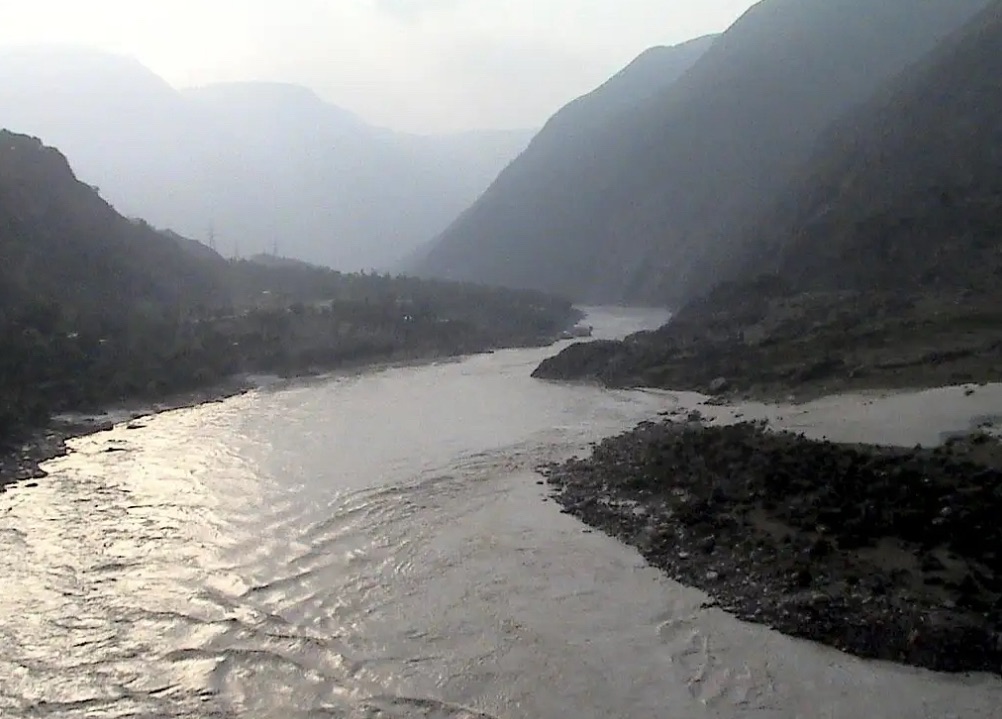
The surrounding mountains are impossibly rugged, and bisected by torturous ravines which lead far back into the invisible watersheds. Stepping down between the smooth boulders that lie strewn along the floor of each valley, the streams, which have their sources far back in the depths of the mountains, finally meet the Indus. The crystal clear waters of these mountain torrents are instantly swallowed by the opaque water of the great river.
The driver of our van exhibits the typical behaviour of all Muslim bus drivers, flinging the van around corners and overtaking in the most inappropriate places. The miles of the Indus Gorge passed swiftly. At around 12:00 PM, we stop for lunch at a locality demarked by a few houses and some oily patches in the grey dust where trucks are serviced. Blue and I eat a delicious meal of beef curry and bread, which the girls pass on. Before eating, I look down into the kitchen which is below ground level on a terrace. The food bubbles in great vats, the air is thick with smoke from the tandoor, and the walls are coated with soot. The smoke adds a nice flavour to our curry.
During the afternoon, the scenery alternates between deep gorges and wide river flats hemmed by steep mountains. Beyond the mountains’ whose flanks descend to the river, even larger monoliths stand, sheer towers of granite and basalt. I think to myself: “There is something vaguely disturbing about mountains. Although they are completely inert, completely implacable, there is something sinister in the way they almost appear to be…waiting, with endless patience; monumental patients. It is as if they know that, despite the claims of puny creatures called men that they can, if they put their minds to it, kick a mountain to powder, the mountains themselves have always been here and always will be.”
Towards evening we catch fleeting glimpses of the ice giants that preside over the entire kingdom of the stone gods of Kohistan. They stand aloof, shrouded in ermine robes of cloud, their jagged shoulders dusted with snow and tattooed with black rock. It is here that, according to the guidebook, are found the sharpest elevation differences anywhere on Earth: 6 1/2 vertical kilometres from the summit of Nanga Parbat (“the naked mountain”) into the adjacent Indus Gorge.

We cross the Indus at Raikot Bridge, and as darkness comes to the valley, we stop for prayers. The summits of several towering peaks catch the last golden light of day, but even this fails to make them look warm. They’re cold and deadly places of death.
Speeding on through the darkness, we arrive in Gilgit at 7:30 and walk down to the Hunza Inn, where Magnus, Linda, and I stayed in January ‘92. The manager, amazingly, recognises me, saying “This is your second visit to Pakistan.” I find our names, along with those of Tim and Joff, in the guest book. The manager even remembers the night we arrived. It was a cold, frosty night and he and his staff were all sitting over a smoking charcoal, brazier to keep warm.
After ice-cold Cokes, we are all soon asleep in our four-bed room.

 CurseOfTheTraveller