We force Blue and Kerry, who are tiresomely late risers, to get up early (6:30 AM) and we walk up to the Jaimat Khana Bazaar, where a Toyota van is already half loaded, mainly with tourists. We have to wait for about half an hour until the off. But soon we are speeding out of Gilgit, past the army base where slump-shouldered soldiers in white T-shirts are lined up doing PT, and out onto the stony wasteland beneath the rocky peaks that stand guard over Gilgit and the surrounding countryside.
As the road winds along the south bank of the Hunza River, after crossing a bridge guarded at each end by stone dragons, the landforms reflect the geology of what was once the bed of a shallow sea called Tethys. When the Indian tectonic plate collided with Asia, the oceanic plate upon which Tethys sat, dotted with volcanic islands, was flipped onto its edge and crushed between the two. Now, the remnants of the marine sediments that covered the floor of the Tethys Sea, along with a conglomeration of different volcanic and basaltic rocks, are being bared by the river, crumbling into the valley to be once again mixed with water after millions of years spent locked in the vaults of the Earth.
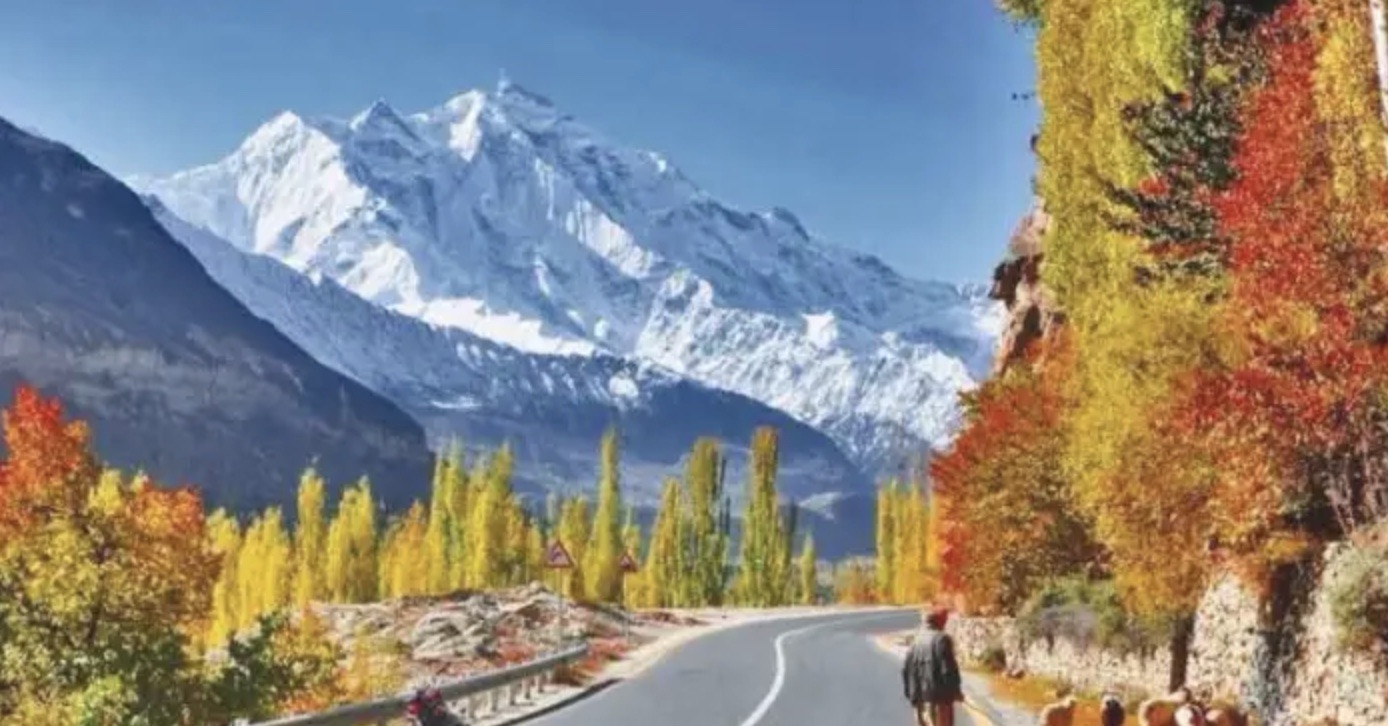
The road winds along the valley, sometimes cut through sheer bluffs far above the river, sometimes following the braided valley floor. At Chalt, the van stops to let the tourists photograph the north face of Rakaposhi. The face of the mountain towers above us, a sheer cliff of ice. From the mountain summit a plume of snow is being lifted by the wind and flung away to the east.
The road crosses the river again and ascends through terraced farmland and groves of fruit trees. Karimabad is, just as we remember it: a single main street lined with shops selling souvenirs and food. There appears to be quite a lot of tourists about: older people, mostly, and rich-looking. We walked down to the Hunza Inn where we had spent our time in ‘92, but it was full, apart from some dorm beds in separate rooms, and the view had been obscured by a couple of new hotels run up by, it seemed, Jerry Builders.
Deciding not to stay there, we walk along to a place called the New Mountain Refuge where we take a bed in a tent for ₹20 each. The New Mountain Refuge has everything a relaxing traveller needs: good food, an honesty system for recording what is used and consumed, comfortable accommodation ranging from dorm beds to wooden platforms, and a wonderful view. We slip into relaxation mode.
Side notes from my diary.
Offered an apple core, a local goat looks up as if to say: “An apple? Do you know how many fucking apples we have up here in Hunza? Why don’t you bring me a fucking apricot? We have them up here too!”
One person was killed and 13 wounded, five of them seriously, in a road mishap near Murree on Saturday. It is reported that a northbound bus met the fatal end when its driver, in a bid to overtake a vehicle, lost control in the bus, which fell into a deep ditch. The matter was reported to the police.
– The Nation 26/9/94.
The chief beneficiary of the fall of the Pahlavi Dynasty was Ayatollah Ruhollah Khomeini, an aged and obdurate cleric, incensed by the Shah’s material values and animated by personal hate born of the Shah’s refusal to allow him to attend the funeral of one of his sons.
– World Politics Since 1945 by Peter Calvocaresi

 CurseOfTheTraveller