After breakfasting on warm Hunza bread, cheese, jam and tea, we sit around talking with one of the Irish guys. He has spent time in Russia and has some interesting comparisons between Russia and China. Mid morning, we shift out onto the small lawn to read, write and talk. The day is warm and sunny, but a few stormy-looking clouds hover about the ragged peaks beyond the river.
At 12:00 PM, Linda and I set off to go exploring. We walk down the narrow lanes of the village, past the school, where the boys, clad and charcoal shalwar chemise are watching two of their number fighting. The girls, clad in blue with white veils and red pullovers, stand in a group along the lane. They all say “what is your name?” and “yes” in unison to us. Some of them are very pretty, with blue eyes and fine facial features. In fact, some of the young Hunza woman could not look out of place at all on the streets or in the schools of any western country.
At the corner shop operated by “Abdul Rasul and Uncles” we have a cold drink each, then walk south along the KKH beneath the towering yellow bluff which dominates the western side of the village. Beyond the town, after a search, we find the path that leads up the Passu River, through thick stands of thorny bushes, to a small glacial lake at the foot of the Passu Glacier. The lake is a pale olive green and its surface rippled by a cold wind blowing down from the row of peaks that make up the southern end of the Passu Massif. The peaks resemble a row of broken teeth protruding from the gums of an old man. Their summits are wrapped in hazy storm clouds.
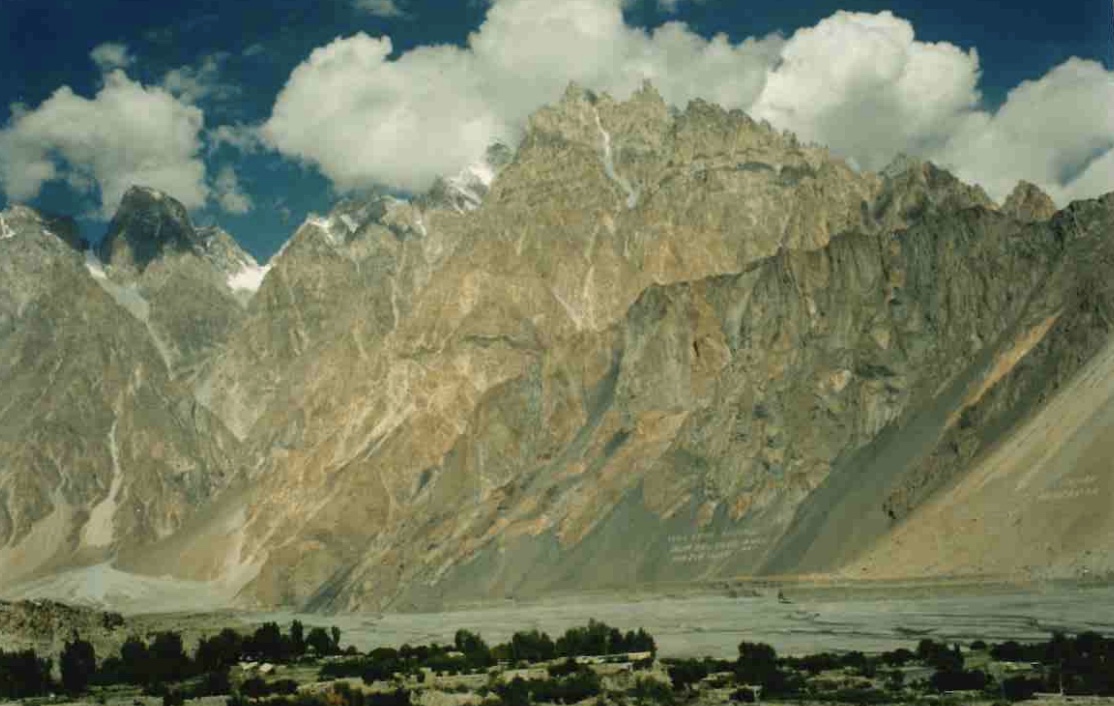
We sit on the terminal moraine of the glacier, a semi circle of shingle which forms the barrier that holds the lake back, eating a Snickers and drinking water. Beyond the lake, blackened ice protrudes from the moraine. Beyond that, a few ridges of white ice are, just visible. There are still plenty of daylight left, so we decided to walk up to the vantage point above the lake. The path is marked by small piles of stones and it leads up through a jumble of moraine debris and under some cliffs which look quite unstable, so we hurry.
From the cliffs, we climb up a steep gully, emerging on the lateral moraine beside the ice. The view is quite spectacular. Directly below, the ice is covered with moraine, but a few hundred metres away the ice is pure white and squeezed into rows of pressure ridges and crevasses. The glacier flows down a long valley and its origin far back in the mountains is shrouded in black storm cloud. A strong, cold wind blows directly down the valley, whipping up the fine glacial dust, which coats everything around us.
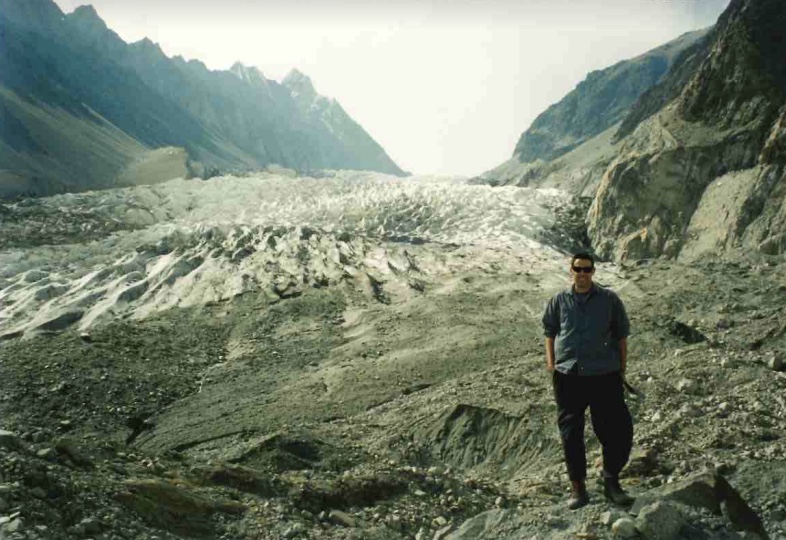
We spend ten minutes beside the glacier; long enough to have a snack and take some photographs. The sky above the glacier and the surrounding mountains looks quite threatening, so we descend to the lake again. On the way down, an old man comes striding down past us and on down to the edge of the lake. As we begin the traverse beneath the bluffs we see him waving to us as if to say “don’t go across.” As we did on the way up, we hurry across, Linda in front and me behind, keeping an eye above us for falling rocks.

The walk back to Passu takes about half an hour and we follow a small lane down from the road through the village. Yaks graze small walled fields, some with young, fuzzy and gangling and with black glittering eyes. Filthy children call “allo” as we pass. Women clad in bright dresses peer from the dark doorways of sod houses. Beyond the river, the shadows lengthen on the scree slopes and faces of the mountains.
We pass a pleasant evening of travellers’ storytelling at the inn.

 CurseOfTheTraveller