Author’s Note: The following text takes up the story a few days after we left Ürümqi and headed for Turpan. The narrative jums around a bit however I decided to reproduce it the way it appears in my diary.
Sunday morning at the Holiday Inn and we sit at our table writing. The restaurant, which was earlier full of people, is now almost empty, and the waitresses are noisily packing up the breakfast things. The ¥75 each that the buffet cost was well worth it, just for the orange juice, of which both of us have consumed about a litre. It tastes wonderful.
In these plush surroundings, I must try to describe the journey from Ürümqi to Turpan, which was perhaps one of the most evocative and beautiful of any of the journeys we have made on this trip. I ask the waitress, whose name is Alice Zhang, for a refill of coffee, then focus my mind on the desert.
*****
Crammed into a decrepit bus, we rattle out of Ürümqi, passing through a narrow gap in the south wall of the city. Snow blankets the landscape, filling the hollows and rounding off the rough edges. Several cement factories expel clouds of steam across the narrow valley down which we travel. Atop a hill of glittering white, a huge radio tower stands over a cluster of buildings. Beyond the outskirts of the city, the road winds through a jumble of low hillocks. The sun, which has managed to break through the thin, woolly-grey clouds which always hang in the sky after a snowstorm, has gone to work on the snow, softening it, turning it to slush, then water. It gleams on the pooling water as if admiring its handiwork.
A wide valley, almost a plain, opens before us. Distant mountains, encrusted with snow, seem to prop up the clouds like Rococo pillars. The valley slopes gently from west to east, towards the Turpan Depression, which is still 160 km away to the southeast. A factory steams in the cold air out in the centre of the valley, its smokestacks trailing clouds of smoke off to the east. From a tall, thin stack, an orange gas flare burns, leaving a thick, oily stream of black smoke. Some distance from the factory, cooling ponds steam like witches’ cauldrons.
The road is arrow-straight, a ribbon of black stretched across a beige ground. Telegraph poles march alongside the road like victorious peasants returning from a rout. In the distance, clusters of wind turbines whirl in perfect synchronicity beside the road. As we approach, I become entranced by the scene. The huge propellers spin in harmony with the wind. As each row aligns as we pass, they present complex patterns of motion for an instant, then separate into synchronised units again.
Inside the rattling bus, there is no chance to listen to them, but I can imagine the sharp chopping sound they must be making as they spin through the air. Passing along beside these gigantic windmills, I am seized by the impression that we are somehow travelling through a Pink Floyd album cover. The starkness of the azure sky above the brown earth. The backdrop of black, jagged mountains, wracked by storm cloud and covered in snow. The straight, monolith rows of towers, topped by giant veins, and the polarised clarity of the entire scene. I can almost see a man wearing a suit of lightbulbs, a blackened tree with upturned twisted branches, a steel face composed of two glowering profiles, an English village amid the bareness of winter, beneath a sky crisscrossed with vapour trails.
Several of the windmills are still, their three veins splayed out like the arms of a crucified man, arms akimbo on a cross. Near the windmills, thousands of poplar trees have been planted in long, orderly rows. In the flat autumn light, their leaves are pale olive green and grey. The wind hustles through them, denuding them and causing the thin, supple trunks to bend to and fro.
The mountains along the edge of which we travel are unbelievably black and hostile looking. They appear as if they are the slag heaps where all of the material that was left over at creation was thrown. Ridges and spurs reach out across great screes of shattered rock like the skeletal fingers of a long-dead corpse. At the edge of a sallow-looking lake, a small town stands, its existence dependent on salt which is mined from the edges of the lake. The town is bleak, rubbish strewn and grubby, with piles of filthy salt lying everywhere amid rows of depressing houses. What a hellish place to live.
We follow a valley which cleaves a range of mountains, the road winding along the bank of a swift river. The wind hurtles through the valley, lifting spray off the water like steam and thrashing the trees which line the banks. A man, trussed up in woolly coats and a huge furry hat, leads a camel along the stony floor of the valley. He is accompanied by two wind-blown dogs. Beyond the valley, the road steadily descends through a landscape of bare, uniform rock, barren and lifeless. The broken rock of the desert is a purplish black and looks as if it had been rolled flat.
Across this expanse of nothingness, the road stretches in a series of shallow zigs and zags, until the oasis of Turpan appears, glowing in the hazy, dust-filled air. The bus deposits us at the central bus station – a dirt compound behind the main street – and we walk up to the Turpan Guesthouse, where comfortable dorms in the old, back wing of the hotel cost ¥15 each. Starving hungry, we dine at a sidewalk restaurant with the two Brits we met in Passu, Roy and Jenny.
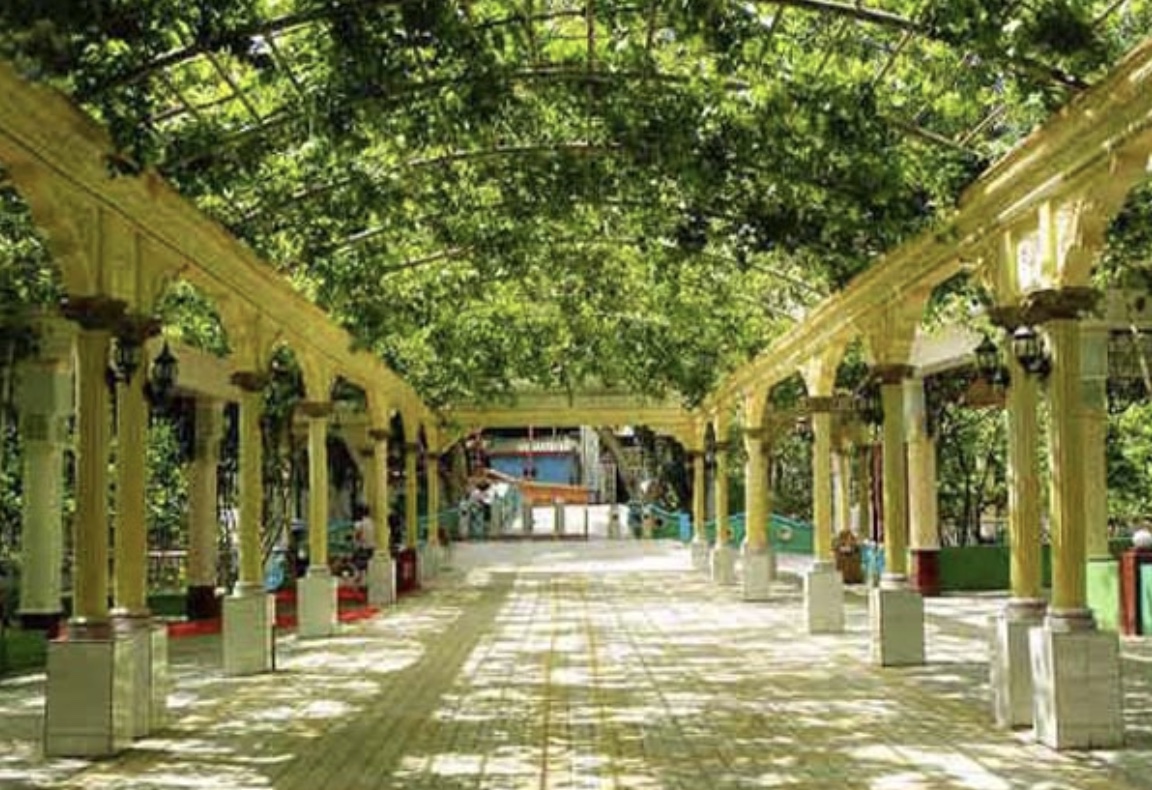
FRIDAY, OCTOBER 14, TURPAN. In his book Riding the Iron Rooster, Paul Theroux describes Turpan as “a town straight out of the Bible, with donkeys, grape arbours, and mosques.” The town is quiet and atmospheric, but, like other oasis towns, there isn’t much to do. We all sleep late, then walk up to one of the cafes for breakfast. I have a delicious bowl of noodles, meat, and green vegetables, and Linda has a plate of scrambled eggs with tomatoes.
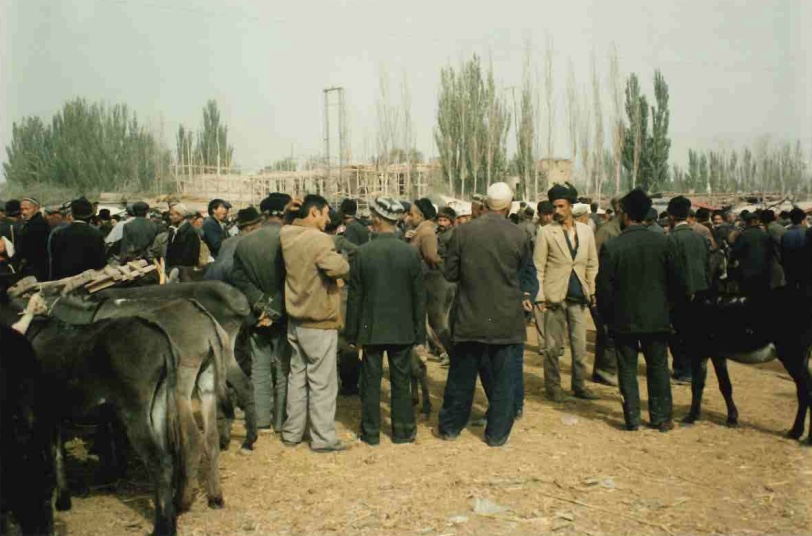
The local market is a smaller version of the Kashgar Sunday market, but we visit it en masse —Blue, Kerry, Mike, who arrive during the night, Linda, and I — for a look anyway. The livestock compound is jammed with people buying and selling animals, mainly sheep, donkeys, goats, and cattle. I watch, to great local hilarity, the procedure for selling the cattle. An intermediary, like a stock agent in New Zealand, brings buyer and seller together, and the price is negotiated. In the final stages of bidding, the intermediary extracts a note from the buyer’s roll of money, then places it in the buyer’s hand. He then slaps the buyer’s hand into the hand of the seller. If the seller accepts the price, he takes the money; if not, he rejects it. Presumably, the mediator takes a commission for his efforts, and a lot of money was changing hands. I calculated that each beast went for about ¥200.
Becoming tired of sightseeing in a group, (and travelling in a group…read on!) Linda and I give the others the slip and set off to walk to the Emin Minaret, on the edge of town about three kilometres away. It was a pleasant walk in the long back lanes of the town, where wooden gateways gave us views into the walled compounds where the citizens of Turpan have their homes. The lanes were lined with poplar trees, and water ran in open ditches along the side of the streets. Grubby children played in the dirt and shouted, “Bye-bye,” a characteristic that Vikram Seth noticed in his book, From Heaven Lake, as we went past.
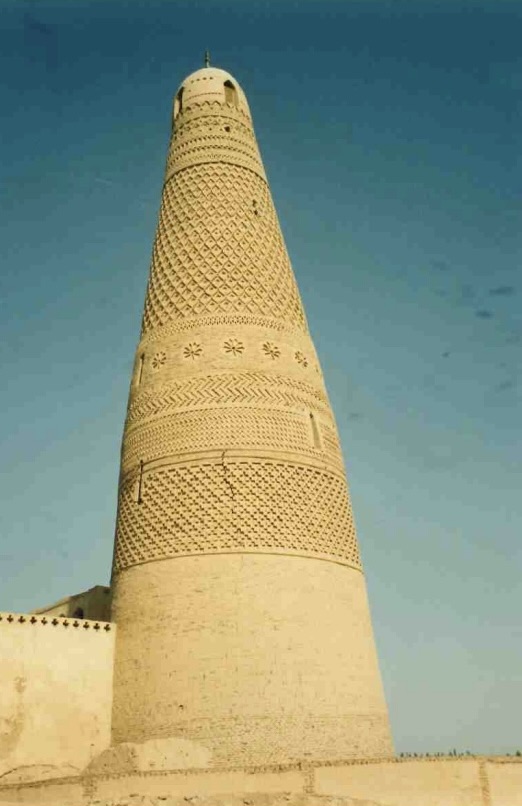
The minaret was well worth the walk. Built entirely of mud, it has a graceful tapered shape and stands amid a number of brick kilns, with which it competes for the attention of one’s eye. The surrounding land was a sea of grape arbours, the grapes now harvested, but the foliage still thick and lush.
The minaret and its attendant mosque were built on a mound of earth, and we clambered up through a cluster of cylindrical graves. Several of these have collapsed, and bleached piles of human bones are scattered about. We enter the minaret’s compound via the back entrance and are shouted at by the guard. Ignoring him, we walk into the mosque where about a hundred Uyghurs sit listening to a Mullah. The mosque consists of a large square room, its palm leaf and sod ceiling held up by several dozen poles. Light enters through a rectangular hole in the ceiling.

We stand quietly watching until the guard finds us and takes us to his office, where he demands that we pay ¥8 each, more than twice what the local people pay. We refuse, and he gets quite angry, but we just sit down and keep offering ¥6, the local price for two people. The confrontation takes an unexpected and decidedly unpleasant turn, however, when he produces an electric cattle prod and waves it at us. We decide to let discretion be the better part of valour and pay the full price.
Although our enjoyment of it has been marred by the encounter, the Minaret is a very fine example of classic Arabian architecture, with its bulbous tapering shape and its rhomboid decorations. As we were walking out, we met another couple of backpackers coming in through the back entrance. We warned them in time for them to escape without paying, although they are still threatened with the cattle prod before they can talk their way out.
Back at the hotel, Mike, Blue, and Kerry are making a big noise about how much they are going to drink at dinner, and they are already well on their way, having consumed a bottle of white whine – oops, Freudian slip – wine. When we decline to accompany them to the restaurant, it is still only 4pm after all, we are greeted with snide remarks about people who don’t drink.
Later on, when we finally join them, Mike has become quite obnoxious, an unusual trait for an American, and Blue and Kerry are prattling on about “getting seshed” [drunk]. Mike is making a big deal of his ability to speak Chinese, and insists on ordering for us and telling everyone who wants to listen what is being said. For his part, Blue tries to mimic what Mike says, and the whole thing is pathetic, and for us, very uncomfortable.
Writing this now, it all sounds a bit childish and unimportant to have taken offence at. But still, both Blue, with his ridiculous “I’m a Kiwi” attitude and his ignorance of even basic facts about places we have visited, and Kerry, with her pathetic incapability to make even the simplest decision, have become almost unbearable travelling companions. We resolve, back in the hotel, to leave them to their own devices, and set off on our own back to Urumqi. After all, they have their new big rude friend Mike — “Mike did this, Mike said that” — to look after them, so they hardly need us to shepherd them along anymore. Feeling smugly triumphant that we have finally made this decision, which has been impending for some time, we go to sleep.
SATURDAY, OCTOBER 15TH.
If Blue and Kerry are surprised when we tell them at 8:30 am that we are off, they make a good job of hiding it. Packing up, we say goodbye and leave them, walking around to the bus station where we jostle aboard a battered bus. Most of the other passengers are Uyghurs, dark-skinned, short people with dark, vaguely sly eyes. The Uyghur garb is typically brown pants, a blue jacket, and a peaked cap of navy or brown. This dress gives them all a uniform, almost peasant look.
The return trip to Urumqi is uncomfortable and long, broken only by a stop for toilet and boiled eggs halfway through the valley. I watch the bus driver, who has a countenance like a fish—round face, bulging eyes—stuff eggs into his mouth. Urumqi is cold and clear. We take a public bus from the bus station to the railway station, but confronted there with massive queues for hard sleeper seats, kept in line by PSB men wielding cattle prods, which resemble tasers. We decide to let CITS (The China International Travel Service) do the legwork for us.
Another bus takes us back to the Hongshan Hotel, where the service is as friendly as ever. Before we book into the dorm, I go up and make sure that the four dickhead Swedes and the moron Australian are gone. They are, and the other Swedish guy, who was there before, is still propped up on one of the couches, recovering from a bout of giardia. As I walk in, he says with a grin, “Yes, they are gone.”
Later on, we fill up with delicious dumplings and bok choy at one of the small joints beneath the bridge. Before returning to the hotel, we walk down to the Holiday Inn. Linda asks the main desk if they accept Visa and MasterCard, which they do, and we make a mental note that we will partake of a buffet breakfast on the morrow. In addition, I buy two rum balls from the delicatessen, which we eat back at the hotel while playing last card.

7PM, ABOARD “THE IRON ROOSTER” EN ROUTE FROM ÜRÜMQI TO LANZHOU.
We linger in our sumptuous breakfast-time surroundings as long as possible, eventually paying by MasterCard and packing up. Before leaving, we stash away two boiled eggs, salt and pepper, some packs of Anchor butter, and some Austrian marmalade for the Swedish guy (we never do find out his name) back at the hotel.
On the mezzanine floor of the Holiday Inn, the Business Centre—computers, fax, telex, etc.—has the latest copies of Newsweek and Time, and we sit for a while at a comfortable sofa, reading about the horrifying sinking of the ferry Estonia, with the loss of 912 lives. Apparently, the ferry’s bow doors were battered open by high seas, allowing water into the hold which destabilised and ultimately overturned the ship, which sank in less than 15 minutes. Most of the dead remain inside the wreck, 80 metres beneath the sea. Only 195 people survived.
There was also news about the plague sweeping India, which has now claimed 300 lives and shows no sign of being brought under control. Since first hearing about this plague — bubonic, pneumonic, and septicemic — three weeks ago while we were still in Pakistan, we have met several travellers who have modified or changed their plans to visit India. Not from their fear of contracting the disease — not that that fear would be unwarranted, considering it wiped out 25% of the population of Europe during the Middle Ages — but because of the quarantine restrictions which might be forced onto them upon returning home.
Before we leave the Holiday Inn, I help myself to a roll of toilet paper. Then we are let out of the polished brass doors by a grinning young man dressed in a bright yellow bellhop suit. His nametag says that his name is Eric Yu.
We fill in the rest of the morning buying provisions for the journey to Lanzhou. At one of Ürümqi’s large department stores – Mao must be spinning in his glass case – we buy bread, tea, water, and wine. We also buy four decks of cards decorated with dynastic warriors for presents, and a tape of Madonna’s greatest hits. As we had walked into the store I had heard “Like a Prayer” playing, and it sounded so comfortable and familiar amid the crescendo of screeching Chinese music that we bought a copy for a mere ¥10.
Entering Urumqi railway station, our luggage is x-rayed. The woman watching the screen spies one of the two Uyghur knives I had bought in Kashgar and tries to take it off me. I refuse to let her have it, citing the fact that most of the Uyghurs who had walked into the station probably have them attached to their belts. After a five-minute discussion, she lets me go. We join the huge throng of people seated in the waiting halls and watch as the riffraff, the holders of hard seat tickets, are let through onto the platform in a pushing, jostling horde. The lines are kept in order by a handful of uniformed women who exercise supreme and unchallenged control over the rank and file.
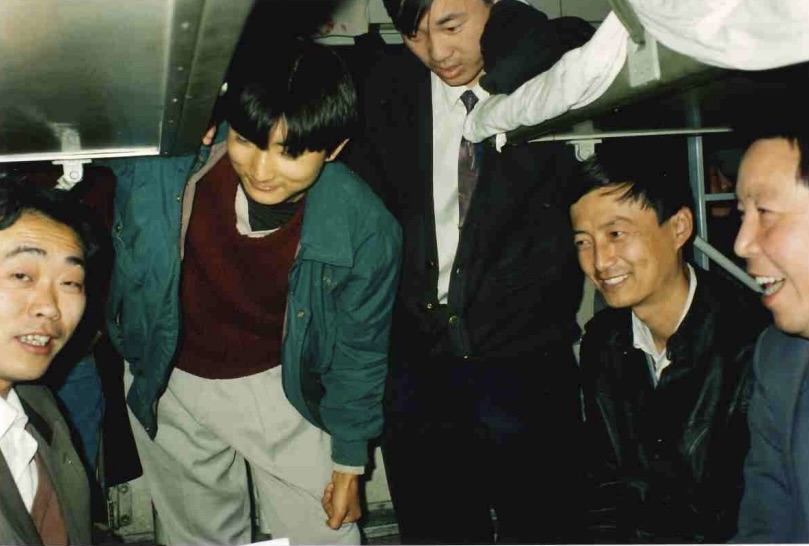
The procession of hard sleeper passengers onto the platform is more orderly, and soon we are in our respective bunks in Car 14. The train departs precisely at 3:25 pm and slides out of Ürümqi, past factories belching smoke and dust which coats the surrounding land with grey. We are reasonably lucky in sharing tiers 7 and 8 with some quite tidy and polite people. The cubicle next door resembles a cage in a zoo. Food scraps cover the floor within a few minutes of leaving the station, and I watch a man eating seeds, no expression on his face, ejecting the seed pods from his mouth to collect on his lap without any apparent concern.
The atmosphere of the entire car is soon blue with cigarette smoke, and it becomes almost unbearable towards evening as people finish their evening meal and light up. Before beginning its passage through the range of mountains that separate the Ürümqi Basin from the Turpan Basin, the line crosses an area of hummocky swamp upon which graze herds of goat and sheep and a few shaggy horses. The air is hazy and in the distance to the north, the mountains are clad in a coat of snow which will last for the duration of the winter.
The line follows narrow valleys and passes through several short tunnels. The hills are like piles of cinders, black and severely eroded, scarred by rills and gullies and devoid of vegetation. Evening finds us out in the desert near Daehan. In the late evening sun, the nearby mountains take on the appearance of sand dunes, all ridged and crinkled, shadow and light giving them the three-dimensional appearance of a contour map.
After dark, which is preceded by a purple glow that seems to infuse the entire universe, we adjourn to the dining car for a quick meal, then drink wine and play cards until 9 pm when the smoke becomes unbearable and we retire so that we can close our eyes. Linda has the top bunk (上) and I have the bottom (下).

 CurseOfTheTraveller