We spend the morning hanging out in Peter’s Café across the street from the hotel, drinking coffee and swapping yarns with Ron and Yvonne, and Don, the English chap we met in Chengdu. It is quite cold, but sunny and clear, and after the rigours of the previous two days and nights, it is nice just to sit and do nothing.
At midday, Linda and I wander down to the fabulous old part of the town. Here, in stark contrast to the architectural travesties of the modern Chinese part of the town, the buildings belong to another era. The narrow cobbled streets are alive with life, with vendors selling all manner of goods. In the market square there are stalls selling a variety of tourist-oriented tat, some of which is OK, but most of it junk.
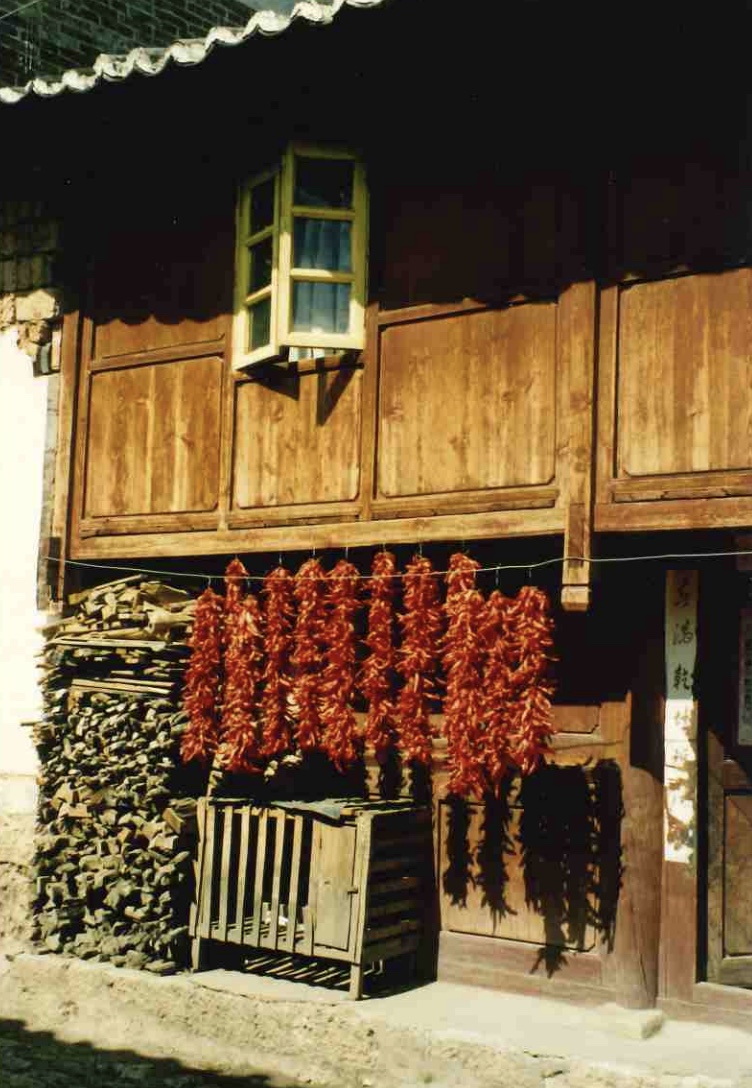
We wander for hours around the narrow streets, overhung with carved wooden eaves, where clusters of bright red chillies are hung out to dry. Each house has a wooden box containing a hen and a brightly-coloured parakeet, peering from ornate cages. Yellow flowers like ragwort grow in the blackened tile gutterings, a colour scheme which reminds me, for some reason, of Laycock Village in Wiltshire. We follow a stream, contained in a concrete channel, back to the Chinese part of town, and then back to the hotel.
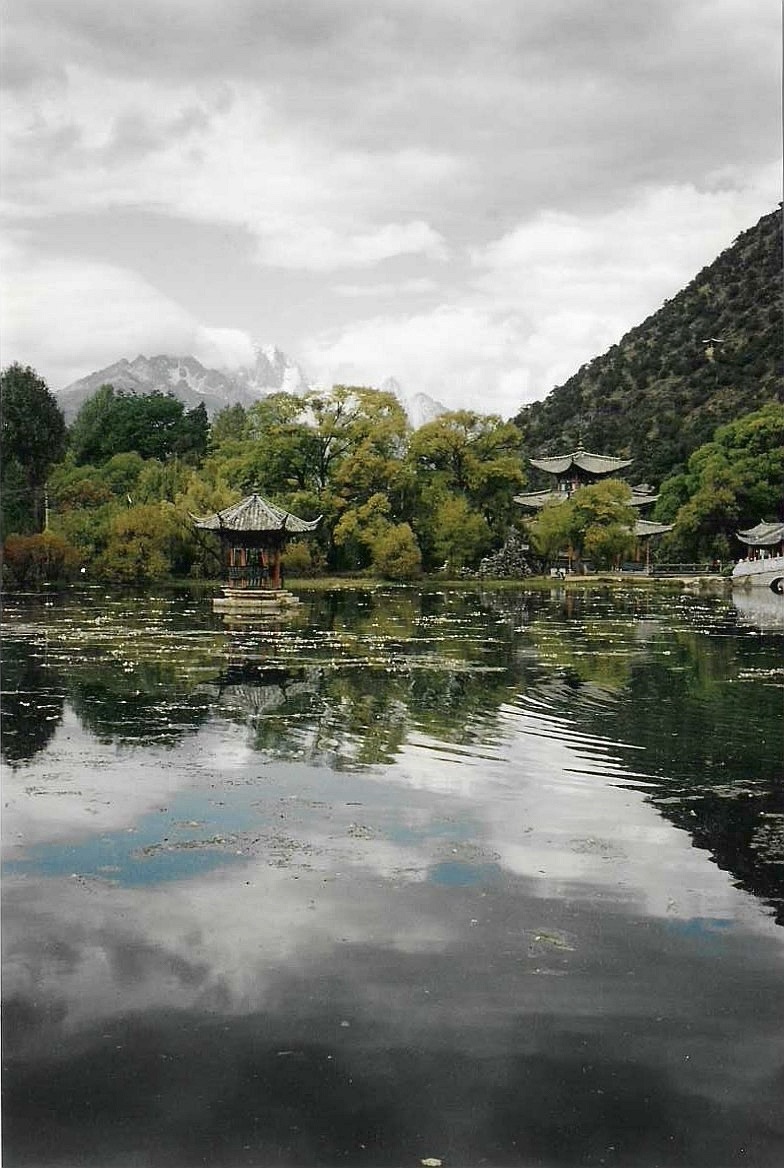
Later in the afternoon, we wander down to the park and walk around a small lake known as Black Dragon Pool. The water is crystal clear, and the pool is ringed with willow trees in their autumn colours. In the background, the ever-present Jade Dragon Mountain is shrouded in a wreath of storm cloud. The park is unusual in that it is very pleasant, a rare accomplishment for a Chinese park, most of which are tacky and awful, and always contain speakers hidden in the trees, blaring out tinny music.
In the evening, we dine at a restaurant called Mama Fu’s, which serves excellent Western food. I opt for steak and chips, Linda has chicken and chips, and we finish with chocolate cake. Back at the hotel, we watch the English news. Bill Clinton witnesses the signing of another peace treaty between Israel and Jordan. Russian hijackers released all of the captives from an aircraft they had hijacked after payment of a $2 million ransom. Then a program about the Red-Crowned Crane, a bird of China’s northern provinces, comes on. At one point, the narrator says, “The universe has endowed nature with many unique wonders. To avoid experiencing extreme melancholy that the destruction of the environment would cause, we must protect it.” Extreme melancholy?

 CurseOfTheTraveller