We leave the hotel at 8.15am and set off to climb up to the Zhonghe Temple, perched halfway up the forest-clad mountain standing above the town. The temple’s red tile roof is just visible amid the deep dark green of the forest as we walk up a cobbled street towards the foot of the mountain. In the early morning sun, the webs of giant striped spiders shimmer like spun glass draped between the trees and around the eaves of buildings.
The cobbled street becomes a narrow concrete lane between stone walls, then a dirt path leading out of the village and up through the terraced farmland of a small valley. Below the town, Erhai Lake is hidden in haze, but above us the mountainside is clear. The path is worn deeply into the clay in places, and it winds gently upwards through the terraced fields where locals toil amongst neat rows of vegetable seedlings. The valley ends in a cup-shaped amphitheatre at the foot of the hill, and the path begins to ascend steeply through groves of eucalypt trees.
We stop often for rests – there’s no need to hurry – and at one stop a group of women carrying baskets overtake us. They pause to jabber at us for a while, and we are sure that they are telling us to get a move on. The climb steadily proceeds upwards, passing an area of graves, concrete tombs built into the hillside, then entering the forest. Composed mainly of small conifers, the forest is cool and shady, with the wonderful clean smell that characterises stands of pine. The temple is still invisible above us, hidden by the trees, and by its location atop a knob.
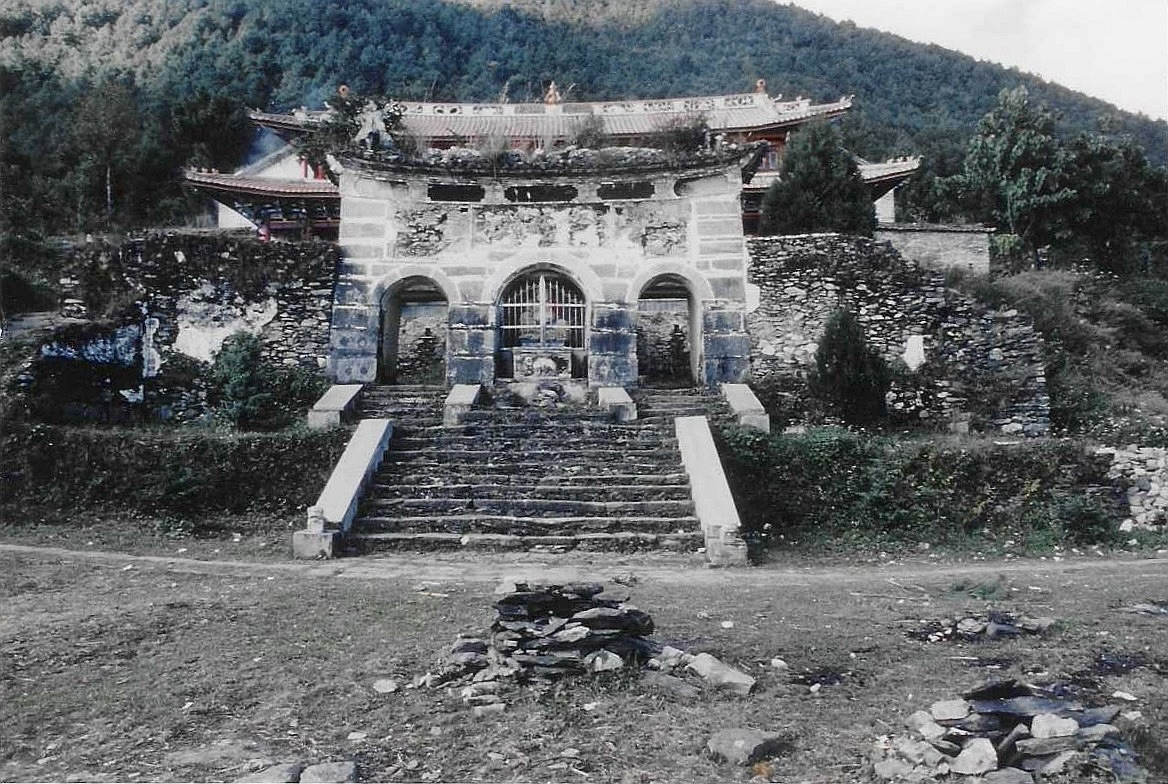
We follow a cobbled path, in some places rising steeply upwards in a series of steps, in other places traversing the hillside in almost flat stretches. It takes about two hours to reach the temple, which is presaged by two tumbled-down stone buildings containing small altars upon which are placed small cups of rice wine, paper, and incense.
The temple is guarded by a grinning Buddha seated behind a steel grill. Steps lead up through an ornately decorated gateway where brightly-coloured dragons, elephants, and birds stare outwards overhead. The air is thick with smoke from burning incense and pine, at once acrid and fragrant. An old lady greets us with a warm smile and an offer of a cup of tea, which we gladly accept.

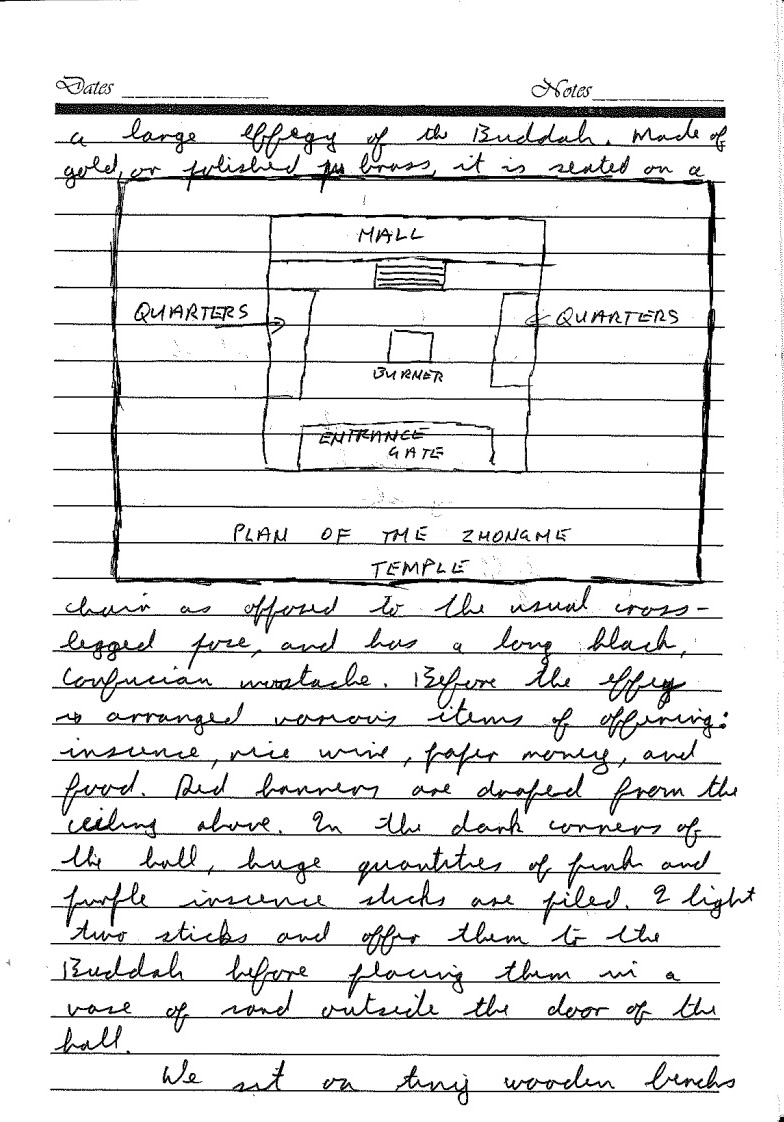
The temple consists of an inner courtyard containing a large burner, around which stand living quarters, and at the back a large hall containing an immense effigy of the Buddha. Made of gold or polished brass, it is seated on a chair as opposed to the usual cross-legged pose and has a long black Confucian moustache. Before the effigy are arranged various items of offering, incense, rice wine, paper money, and food. Red banners are draped from the ceiling above. In the dark corners of the halls, huge quantities of pink and purple incense sticks are piled. I light two sticks and offer them to the Buddha before placing them in a vase of sand outside the door of the hall.
We sit on tiny wooden benches on the veranda outside the hall, drinking the fragrant tea and enjoying the solitude of the temple. Apart from the old woman and her husband, the place is deserted and is quiet apart from the crackling of the pine boughs burning in the burner at the centre of the courtyard. The sunlight is strong and shines down through the smoke from the burning wood which hangs in the air before drifting slowly off across the trees.

After half an hour or so, we begin our descent, which takes about an hour. Along the way, we meet two other parties of Westerners on the way up. It is getting hot and they are making heavy work of it, but we encourage them onwards with exhortations of the temple’s beauty.
Back in the town, we settle in to relax for the rest of the day at Jim’s Peace Café and relaxing in our room. Caroline and Michelle turn out to be very good company and we pass a lot of time chatting to them. Michelle and I find a common interest in entertainment trivia, and over dinner we laugh about old TV shows and various fates that have befallen some of their stars. Erin Moran, of Happy Days and Joanie Loves Chachi fame, for instance, these days lives in a shelter for the homeless. Poetic justice!

 CurseOfTheTraveller