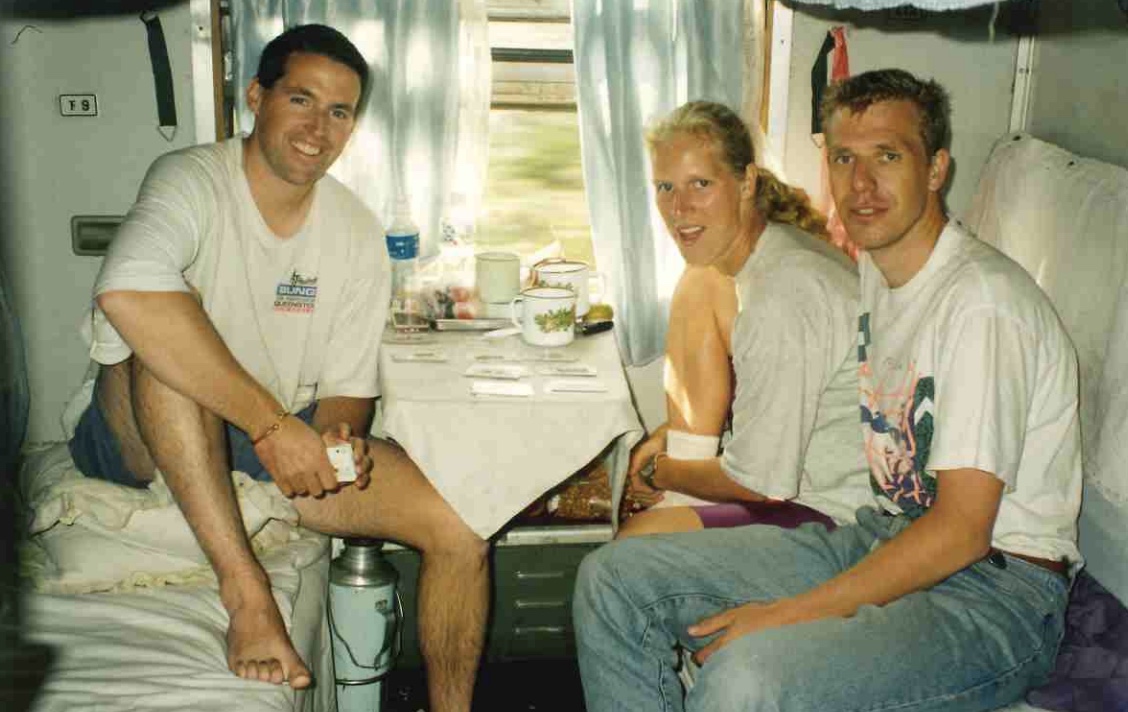
And so at last, we come to our final train journey in China, the Kunming-Guilin Express. Together with our Dutch friends, Ron and Yvonne, we occupy a soft sleeper compartment. It cost a fucking fortune, ¥550 each, but it gives us a degree of comfort that we are unaccustomed to. Clean, comfortable beds, ample space for our luggage, and best and most importantly, a locking door which separates us from the rest of the train. There is no smoke, no spitting, no raucous music, no staring, no inane conversation, and again, no smoke. NO SMOKE!
This morning we sat at a cafe next to the Kunhu Hotel, having breakfast with Dom and our friend George, who we had last seen in Turpan. Ron and Yvonne were also there, having arrived on the overnight sleeper bus from Dali at 4:30 am. At 10:30 we left the cafe and walked up to the station, stopping on the way to visit the exquisite, pristine toilets in the King World Hotel (crap name, nice hotel). In the soft sleeper waiting room, we sat in comfortable armchairs until the charming lady attendant informed us it was time to board.
Dress it up in whatever verbose revolutionary rhetoric you please, soft sleeper is First Class. It is way beyond the pockets of most of the souls now jammed into the other parts of the train. You can talk as much as you like about “elitism” or “classless societies”, but if you can afford to separate yourself from the masses, then do it.

Outside the window, the landscape is vaguely Australian. This might be an exaggeration because, after all, we are in China. But still, I see similarities, and to draw parallels between places is one of the pleasures of travel. To see reminders of home, or places that were interesting or pleasant, or even places that were equally bad.
The soil here is deep red, the colour of blood, like the soil of Australia. Eucalypt trees grow thickly along the track, around the perimeters of fields, and along the roadsides. Yet, the view is typically Chinese: orderly fields of vegetables, rice paddies flooded with water reflecting the sky like a mosaic of small mirrors, fish farm ponds with high embankments surrounding them, and, as always, a background of blue smoky haze. Short stocky ponies graze along the verges of the fields, and peasants in their conical straw hats hack at the soil with long-handled mattocks.
Every nook and cranny is farmed. Every hill, every basin, every cup, every hummock. Beans appear to be the main winter crop, at least around this part of China, and there are thousands upon thousands of fields of them, planted in neat, pale green rows. People stand knee-deep in paddies of mud and water. The reflective surfaces of the paddies are a wilderness of mirrors in which the people keep a vigil. Not exactly my thoughts, but I will borrow it here because it fits. A wilderness of mirrors, of tawny port soil, of a hundred shades of green and brown and blue.
Newly-made bricks are stacked up to dry in the sun, like rows of dominoes set up to break a world record topple. People carry heavy buckets of shit on bamboo poles to the fields, where it will be spread as fertiliser, an unpalatable idea to a westerner, but it is the reason why the fields remain so fertile.
The railway track follows the course of a brown river as it meanders around the foot of a hill, which looks like Silbury Barrow in Wiltshire. Another comparison, but these places remind me of Britain. Where the river is smooth, it is covered by a scum of frothy bubbles, remnants no doubt of the night soil poured onto the fields. But mostly it steps placidly down over small gravelly rapids and curves around past groups of people doing their washing, which is hung colourfully up on the bushes to dry.
On station platforms and pads of concrete, people flail the last of the year’s cereal harvest, threshing out the grain in long, graceful swinging motions, the blades of their flails describing full circles before crashing into the husks. The winnowed grain is spread out to dry everywhere in square, rectangular, and round patches.
The cropping patterns change quickly as the train speeds from district to district. In places, newly-harvested rice is stooked up along the edges of the paddies, awaiting transport to the nearest threshing place. In other places, vegetables form the main crop: great green swathes of cabbage and spinach. As evening comes on, we play cards and talk, then retire to our comfortable swaying bunks, where all four of us sleep very well.

 CurseOfTheTraveller