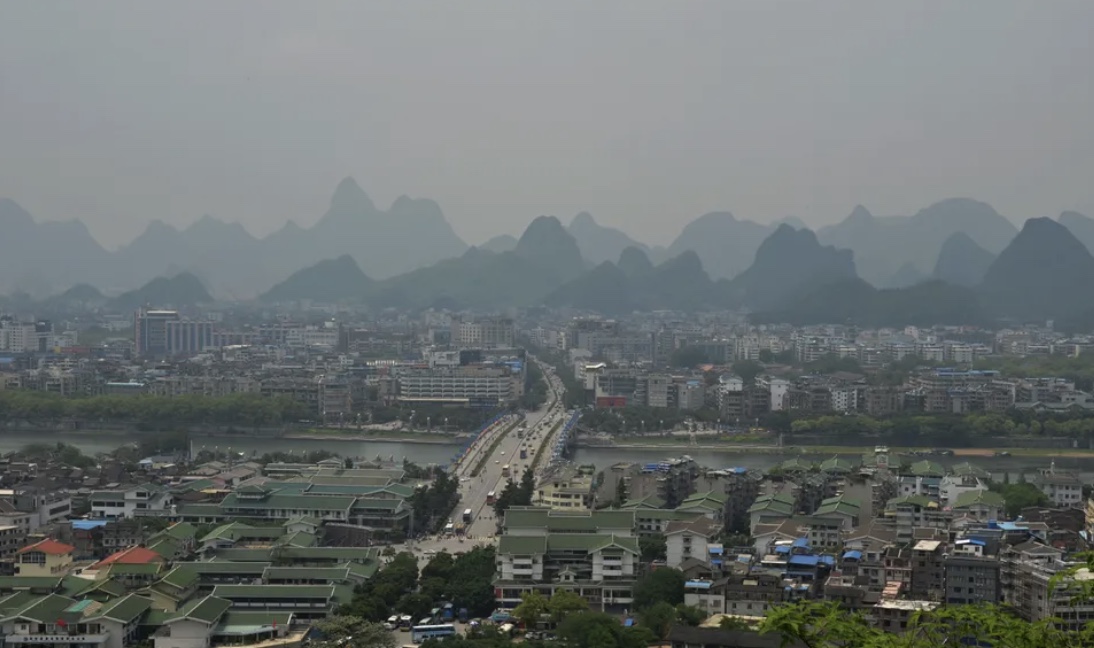
Morning finds us travelling through the moonscape karst mountains of Hunan province. The limestone pinnacles, clothed in green and barren scrub, jut from the landscape like teeth in the cavernous mouth of a prehistoric creature. In the narrow valleys which wind through and around the hills, people are already at work, planting, hoeing, harvesting. All of their activities dwarfed by the limestone peaks that tower over them.

At first the air is clear, a little smoky perhaps, but still reasonably free of the blue haze which begins to gather as the day warms up. The temperature is noticeably warmer, and by mid-morning we have the window full up and are in shorts and t-shirts. In the afternoon the haze shrouds the peaks, making them indistinct and ghostly. They appear as poor huddled masses awaiting processing for entry into America, standing shrouded in garments to keep out the rain, row upon endless row of them, rolling back into the distance, linear perspective giving each successive row a lighter shade of blue and giving depth to the whole scene.

The vegetation is now tropical, green, lush, verdant. Bamboo grows in great bushy forests, through which flow streams of aquamarine, and heat hangs thickly in the air. This is not the dry, burning heat of the desert, or the high African savannah. This is the humid, sticky heat of the jungle, of tropic coastlines, where fat clouds hang on the horizon, always promising rain, but never delivering. It is the languid, enervating, cold-beer-drinking heat of Zanzibar, where the surf of the Indian Ocean hammers on the reefs. The malarial, cicada-droning, mosquito-filled heat of the Congo Basin, where people huddle in their huts by night, lest the darkness of the jungle, and all that it contains – eyes and teeth, and the noises of death – engulf them. Awaking from these queer thoughts, I watch out the window as the train pulls into the town of Lanzhou at 4.20pm.
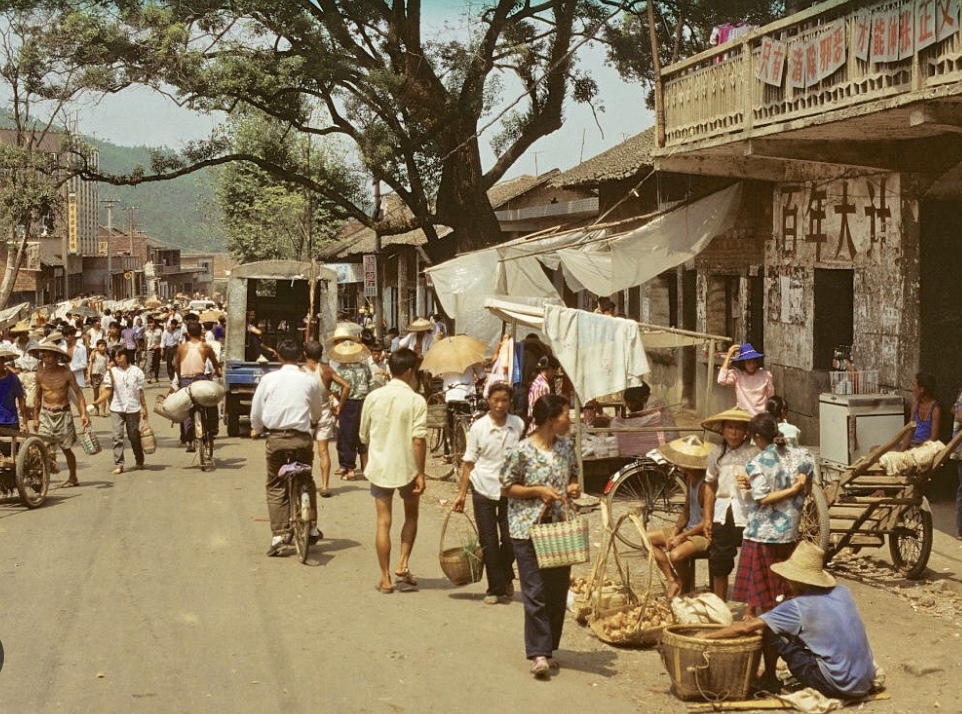
Between Lanzhou and Guilin, the landscape is blighted by industry, and the smell of burning coal hangs in the air like a shroud. At each station, crowds of locals carrying huge bundles run to the hard seat section of the train, clamouring around the doorways to get aboard.
Dusk falls as we pass along the bank of a gentle glassy river, upon which small boats float motionlessly and limestone rocks appear as basking hippos. The sky is an exquisite shade of pale purple, changing to a rich rosé pink in the sky above the setting sun. The fields are empty now of people as the land catches the last glow of the day. Cicadas sing in the bamboo, and the air cools as evening becomes night. I’m reminded of the words of a Genesis song as I watch the light fading out in the western sky.
FAR AWAY, AWAY,
FADING DISTANT LIGHTS,
LEAVING US ALL BEHIND,
LOST IN A CHANGING WORLD.
In the eastern sky hangs the merest gold sliver of a new moon, resting almost horizontally upon the burnt orange smudge of the horizon. The train rattles on in the gathering night, darkness hiding all but the outlines of the mountains, now silhouetted against the sky. The reflection of the sky is also caught in the water of the paddy fields, but these too are soon gone as the last light disappears. Inside the train, in our little lighted cabin, we drink beer and talk until the train rolls into Guilin at 7.50pm.

 CurseOfTheTraveller