This time of day, sipping coffee at a table, on a street, in a town, beneath a jungle-covered peak in China, is a good place to consider the theories of Chairman Mao. I’m inspired by this consideration having just leafed through a copy of The Quotations from Chairman Mao Tse-tung, which I purchased yesterday from one of Yangshuo’s many souvenir stores. Was he an idiot? Was he mad? Yes, I believe he was, at least in his later years, when age and the siren song of absolute, megalomaniacal power had wooed him and diverted him from his original and noble goal, the liberation of China from the Japanese and from the feudal system.
Consider some of these gems culled from quotations from Chairman Mao.
1. The atom bomb is a paper tiger. 2. The east wind is prevailing over the west wind. 3. The imperialists and their running dogs will smuggle their agents into China to sow dissension and make trouble. 4. An army without culture is a dull-witted army.

Here in Yangshuo, we have done nothing. Linda has been sick with a nasty cold, so she has spent her time resting up. I have read and written and gone for the occasional short walk. On Monday, I walked out of the town and into the quiet fields beyond. Turning off the road, I followed a narrow path that led along the edges of tiny fields, crossing a low saddle between two limestone peaks, then finally dropping down into a small secluded valley. Although the haze of pollution still hung in the air, the noise of the town was gone and the valley was silent except for the occasional plop of a carp in one of the fishponds and the churning of a rice thresher in one of the fields.
It was very peaceful, and the cool of late afternoon was pleasant after the sultry heat of the midday. The air was fragrant with the smell of flowers which grew among patches of forest bordering the fields, and with the smell of wet soil and vegetation.
The paths along the perimeter of the fields formed complicated routes through which I navigated. It was like finding my way through a Victorian maze, and I expected at any time to encounter a family of that age – the man in a waistcoat and hat, the woman in bonnet and crinoline, and the children in sailor suits – coming the other way, discussing perhaps the exhibition or the current gossip of London. But of course, I encountered no such party (I’m in modern-day China, not imaginary Victorian england!) and after losing my way a few times, I found my way down to the river, and from there walked back to town.
On Tuesday (8/11/94) I set off in the late afternoon to see if I could gain the vantage of one of the pinnacles in the nearby park, from which I hoped to watch the sunset. The cunning, or mean, Chinese though, have that one well and truly sorted. They charge ¥20 at the gate for entrance into the park in the evening. “But you can see the caves!” the girl said. I didn’t want to see the caves. I wanted to be alone above ground to see the sunset, not prowling in a crepuscular, subterranean darkness. I walked on as the sun set behind the dismal clusters of uniform buildings, beyond which rose, like mist-shrouded tombstones in a bleak Lancashire graveyard, the peaks of the surrounding landscape.
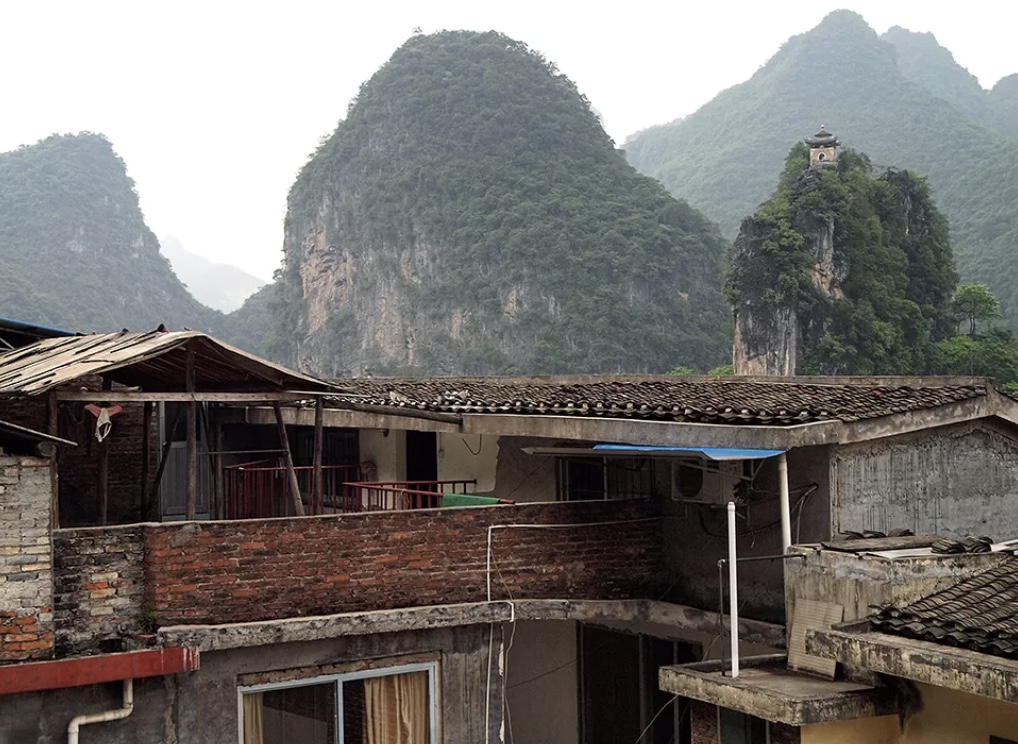
Beyond the town, I walked out into the fields where evening heralded the end of the working day, and people homeward made their way. I stopped often in my perambulation to watch the activity. People watered plots of vegetables using watering cans with long bamboo sprouts, from which the water cascaded like silver fans.
Fishermen sat with the endless patience that must be the nature of every Piscatorialist, whether he sits behind a pool beside a Chinese river, or stands waist-deep in the spay, or patrols the leafy banks of the Kennet below Stockbridge. I walked for an hour or so, out of the town, then returned by a different route, which took me through the narrow back lanes of the town’s outskirts.
In between times, I have discovered Charles Dickens, that great painter of word pictures, who prowled the grimy streets of Victorian London, exposing the decay beneath the genteel facade of respectability that graced the faces of its higher classes. I only wish that I could have discovered him years ago. As it is, I came across a copy of A Tale of Two Cities in a bookcase in a backpacker’s hostel in Dali, and became an avid fan of Dickens.
Dickens’ writing is so deft, so subtle, and in places so sarcastic. For instance, this is his description of the court of Louis XVI: “Everybody was dressed for a fancy ball that was never to leave off. From the Palace of the Tuileries, through Monseigneur, and the whole court, through the chambers, the tribunals of justice, and all society, except the scarecrows. The fancy ball descended to the common executioner, who, in pursuance of the charm, was required to officiate frizzed, powdered, in a gold-laced coat, pumps, and white silk stockings.”
His description, also, of the interior workings of Tellson’s Bank at Temple Bar, is wonderfully evocative of the age: “After bursting open a door of idiotic obstinacy with a weak rattle in its throat, you fell into Tellson’s down two steps, and came to your senses in a miserable little shop, with two little counters, where the oldest of men made your cheque shake as if the wind rattled it, while they examined the signature by the dingiest of windows. If your business necessitated your seeing The House, you were put into a species of condemned hold at the back, where you meditated on a misspent life, until The House came with its hands in its pockets, and you could barely blink in the dismal twilight.”
In A Tale of Two Cities, Dickens, who was a staunch opponent of capital punishment and transportation, embeds numerous references that highlight his beliefs, often with a sharp, sarcastic wit. For example, he notes: “At the time, the year 1780, putting to death was a recipe much in vogue with all trades and professions, and why not legislation? Death is nature’s remedy for all things, and why not legislation’s? Not that it did the least good in the way of prevention—it might almost have been worth remarking that the fact was exactly the reverse—but it cleared off, as to this world, the trouble of each particular case, and left nothing else connected with it to be looked after.”
And so I passed our time in Yangshuo, while Linda did battle with a particularly nasty strain of the common cold virus. On Wednesday, November 9th, we hired bikes in the morning for an exploratory cycle out into the countryside north of Yangshuo. It was scorchingly hot, and after just a few kilometres we were both overheating, Linda especially, with her cold, and we turned back. But the country through which we had cycled was beautiful, and I resolved to return in the late afternoon to take photographs. We passed the day lounging in our room, where it was cool, but not quiet.

At 4pm I set off on my hired bike again, cycling fast out of town, where smoke and dust filled the air, and turning off onto the lane we had followed that morning. I had Jean-Michel Jarre playing loudly on my Walkman, and inspired to exertion by the driving beat of Oxygen 3, I sped along the dusty pitted road. Passing the school where some children had thrown something at Linda that morning, a boy threw a rock at me, unaware that I had seen him pick it up. I immediately stopped and chased him, shouting. He and his friends fled in terror.
Beyond the last clusters of houses, I eased off into a slow dawdle, looking for places and angles from which I could photograph the surrounding hills. After stopping on a bridge which spanned the calm water of the Li River, I left my bike tethered to a post next to a dense grove of bamboo growing beside the river, and walked out into the paddy fields nearby. The evening air was cool and fragrant, the heat now gone from the sun, which was descending slowly into the haze which hung in the air. The jumble of peaks surrounding the area seemed to lose their shape and become indistinct in the bluish-grey miasma of haze.

Setting my tripod and camera up beside a stand of sugar cane, I sat on the earth border of a field of newly harvested rice, and watched the day draw to a close. A man in bare feet and baggy black pants carried a bundle of sugar cane past. Nearby, a woman with a baby sat beneath a red sun umbrella, her silhouette visible through the thin material of the brolly as the sun shone through it. An old woman with a wrinkled, friendly face drove a pair of sleek buffalo by, smiling back at my quiet “ni hao” and making soft clucking noises to the buffalo who plodded ponderously across the soft ground. It was an altogether most tranquil and agreeable place.
After taking some photographs, I cycled slowly back towards town, past the school, past the drab sod and cinder block houses, past the peaks on the outskirts of town, which are inexorably being torn to pieces by workers, the rock destined for building projects and roads.
Linda and I went across to Lisa’s cafe for a meal. Then she returned to our room while I watched Thelma and Louise at the cafe.

 CurseOfTheTraveller